Waveguide squeezed light source
Build integrated nonlinear waveguide sources of squeezed light for compact, robust quantum-enhanced interferometry.
Gallery
Research area
Squeezed light is now essential to gravitational-wave detection – but the squeezer systems that produce it are complex tabletop assemblies occupying full optical tables. We are developing thin-film lithium niobate (TFLN) waveguide optical parametric amplifiers (WOPAs) with two goals: (1) shrink LIGO’s squeezer from an optical bench to a photonic chip, making squeezed light compact, robust, and deployable in future detectors; and (2) build integrated waveguide OPAs as components in quantum photonic circuits – on-chip platforms for generating exotic quantum states (non-Gaussian, entangled) that could push beyond what Gaussian squeezing alone can achieve.
Contents:
- Squeezing in gravitational-wave detectors
- From bulk crystals to waveguides
- The physics of parametric down-conversion
- Why thin-film lithium niobate?
- Recent breakthroughs: on-chip squeezing
- Quantum photonic circuits: beyond squeezing
- Competing approaches
- Technical challenges
- Frequency-dependent squeezing context
- Connections to EGG projects
- Our contributions
- Current status and future directions
- Key references
Squeezing in gravitational-wave detectors
Quantum noise sets the fundamental sensitivity limit of laser interferometers. It manifests in two complementary forms: shot noise (photon counting fluctuations, dominant at high frequencies) and quantum radiation pressure noise (momentum kicks from photon number fluctuations, dominant at low frequencies). Both arise from the same vacuum fluctuations entering the interferometer’s antisymmetric port.
Injecting squeezed vacuum at that port replaces the ordinary vacuum fluctuations with quantum states whose noise is redistributed between the two quadratures of the electromagnetic field. The Heisenberg uncertainty principle requires:
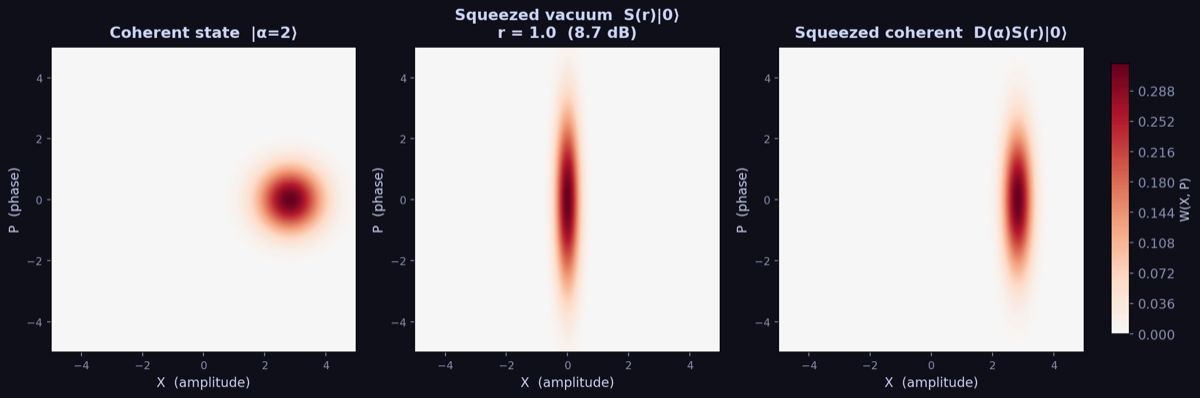
\[\Delta X_1 \cdot \Delta X_2 \geq \frac{1}{4}\]where $X_1$ and $X_2$ are the amplitude and phase quadratures. A coherent state saturates this bound with $\Delta X_1 = \Delta X_2 = 1/2$. A squeezed state reduces one quadrature below $1/2$ at the expense of increasing the other – preserving the uncertainty product while concentrating the noise where it does the least damage.
In LIGO’s O4 observing run, frequency-dependent squeezing (Ganapathy, Jia, Nakano, Xu, Aritomi et al. 2023) reduced detector noise by up to 4.0 dB near 1 kHz and improved the detection range by 15–18%, corresponding to up to 65% more astrophysical events. This was enabled by 300-meter filter cavities that rotate the squeezing angle as a function of frequency – reducing shot noise at high frequencies and radiation pressure noise at low frequencies simultaneously.
The squeezer itself – the device that generates the squeezed vacuum – is a periodically poled potassium titanyl phosphate (PPKTP) crystal inside a bow-tie optical parametric oscillator (OPO), pumped by a frequency-doubled Nd:YAG laser at 532 nm. It works. But it occupies a full optical table, requires continuous alignment, and represents a single point of failure in the quantum noise reduction chain.
From bulk crystals to waveguides
The core physics of squeezing is parametric down-conversion (PDC): a pump photon at frequency $2\omega$ splits into two photons at frequency $\omega$ inside a $\chi^{(2)}$ nonlinear medium. The two daughter photons are quantum-correlated – their joint state is a squeezed vacuum.
The efficiency of this process scales as:
\[\eta_\text{PDC} \propto \frac{d_\text{eff}^2 \, L^2 \, P_\text{pump}}{A_\text{eff}}\]where $d_\text{eff}$ is the effective nonlinear coefficient, $L$ is the interaction length, $P_\text{pump}$ is the pump power, and $A_\text{eff}$ is the effective mode area. The normalized efficiency $\eta_\text{norm} = \eta / (P_\text{pump} \cdot L^2)$ captures the intrinsic material-plus-geometry advantage, measured in %/(W$\cdot$cm$^2$).
| Platform | Mode area | $\eta_\text{norm}$ | Status |
|---|---|---|---|
| Bulk PPKTP (free-space OPO) | ~$10^{-4}$ cm$^2$ | ~0.01%/W$\cdot$cm$^2$ | Deployed in LIGO |
| PPLN waveguide (diffused) | ~$10^{-6}$ cm$^2$ | ~100%/W$\cdot$cm$^2$ | Lab demonstrations |
| TFLN waveguide (nanophotonic) | ~$10^{-8}$ cm$^2$ | ~1,000–10,000%/W$\cdot$cm$^2$ | Rapidly maturing |
The jump from bulk to waveguide is a factor of $10^4$ in mode area – and therefore $10^4$ in normalized efficiency. A waveguide squeezer can, in principle, produce the same squeezing level with milliwatts of pump power that a bulk-crystal OPO achieves with watts.
The physics of parametric down-conversion
Spontaneous vs. stimulated
When a pump photon enters a $\chi^{(2)}$ medium, it can spontaneously split into two lower-energy photons (signal and idler). This is spontaneous parametric down-conversion (SPDC) – the quantum process that seeds squeezing. In the degenerate case relevant to squeezed vacuum generation, signal and idler have the same frequency ($\omega_s = \omega_i = \omega_p/2$) and the process is type-0 or type-I phase-matched.
The rate of SPDC is proportional to the pump power and the nonlinear coupling. Below the OPO threshold, the output is squeezed vacuum; above threshold, it becomes a classical optical parametric oscillator. Gravitational-wave squeezers operate just below threshold, where the parametric gain amplifies one quadrature and deamplifies the other.
The squeezing parameter
Quantifying squeezing: the $r$ parameter
The squeezing operator is $S(r) = \exp!\left[\tfrac{r}{2}(a^2 - a^{\dagger 2})\right]$, where $r$ is the squeezing parameter. The quadrature variances become:
\[\Delta X_1^2 = \frac{1}{4} e^{-2r}, \qquad \Delta X_2^2 = \frac{1}{4} e^{+2r}\]The squeezing level in decibels is $S_\text{dB} = -10\log_{10}(e^{-2r}) = 20r/\ln 10 \approx 8.686\,r$. So:
- 3 dB squeezing: $r \approx 0.35$, variance reduced by factor 2
- 6 dB squeezing: $r \approx 0.69$, variance reduced by factor 4
- 10 dB squeezing: $r \approx 1.15$, variance reduced by factor 10
- 15 dB squeezing: $r \approx 1.73$, variance reduced by factor ~32
The squeezing parameter $r$ scales with pump amplitude and crystal length: $r \propto \sqrt{P_\text{pump}} \cdot L \cdot d_\text{eff} / \sqrt{A_\text{eff}}$. This is why reducing the mode area (waveguide confinement) has such a dramatic effect – it directly increases $r$ at fixed pump power.
Phase matching in waveguides
For efficient PDC, the pump and daughter photons must maintain a fixed phase relationship throughout the crystal – the phase-matching condition:
\[\Delta k = k_p - 2k_s = 0\]In bulk crystals, birefringence or periodic poling provides phase matching. In waveguides, the situation is richer: the waveguide dispersion (determined by geometry) adds to the material dispersion, giving an additional design knob. By engineering the waveguide width, height, and etch depth, the phase-matching wavelength can be tuned precisely.
For TFLN waveguides, quasi-phase-matching via periodic poling remains the primary approach. The poling period $\Lambda$ satisfies:
\[\frac{2\pi}{\Lambda} = \Delta k = \frac{2\pi n_p}{\lambda_p} - \frac{4\pi n_s}{\lambda_p}\]where $n_p$ and $n_s$ are the effective indices of the pump and signal waveguide modes. The waveguide geometry determines these effective indices, coupling material design to photonic engineering.
Why thin-film lithium niobate?
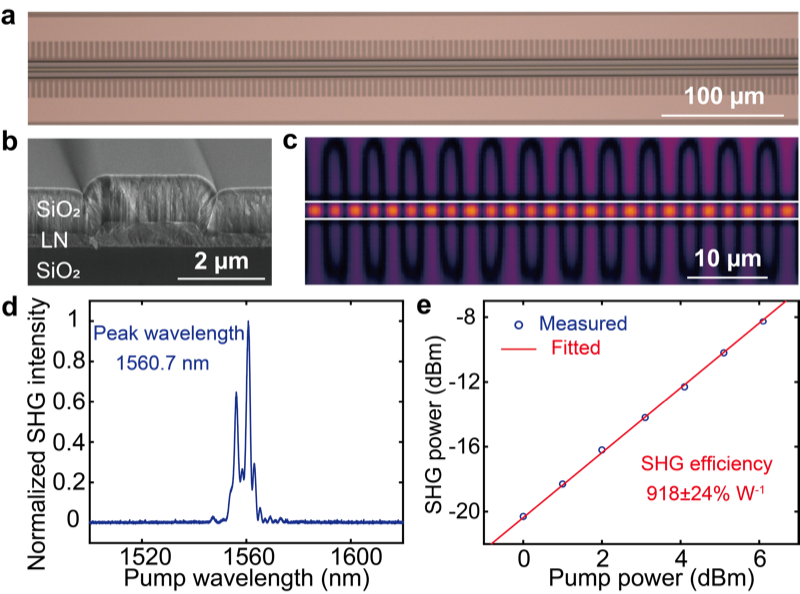
Lithium niobate (LiNbO$3$) has been the workhorse of nonlinear optics for decades – its large $\chi^{(2)}$ coefficient ($d{33} \approx 25$ pm/V), wide transparency range (350 nm to 5 µm), and mature fabrication make it the default choice for frequency conversion. But traditional lithium niobate waveguides (made by titanium in-diffusion or proton exchange) have weak mode confinement – mode areas of ~10 µm$^2$, only ~100x smaller than free-space beams.
Thin-film lithium niobate changes this dramatically. TFLN is a ~300–600 nm thick single-crystal lithium niobate film bonded to a silicon dioxide substrate (the “lithium niobate on insulator” or LNOI platform). Waveguides are etched directly into this thin film, creating ridge structures with mode areas of ~1 µm$^2$ – another 10x reduction over diffused waveguides.
The advantages of TFLN for squeezing are:
- Extreme mode confinement: ~1 µm$^2$ mode area gives normalized efficiencies of 1,000–10,000%/W$\cdot$cm$^2$, compared to ~0.01%/W$\cdot$cm$^2$ for bulk PPKTP
- Lithographic control: Waveguide dimensions defined by electron-beam or deep-UV lithography, enabling reproducible fabrication at wafer scale
- Electro-optic tuning: LiNbO$3$ has a large electro-optic coefficient ($r{33} \approx 31$ pm/V), enabling fast electronic phase tuning without temperature changes
- Integration potential: Pump lasers, modulators, splitters, and detectors can in principle share a common LNOI substrate
- Low propagation loss: State-of-the-art TFLN waveguides achieve <0.1 dB/cm propagation loss, approaching the requirements for high-quality squeezed state generation
Recent breakthroughs: on-chip squeezing
The field of waveguide squeezing has advanced rapidly in 2024–2025, with several groups demonstrating squeezed light from chip-scale TFLN devices.
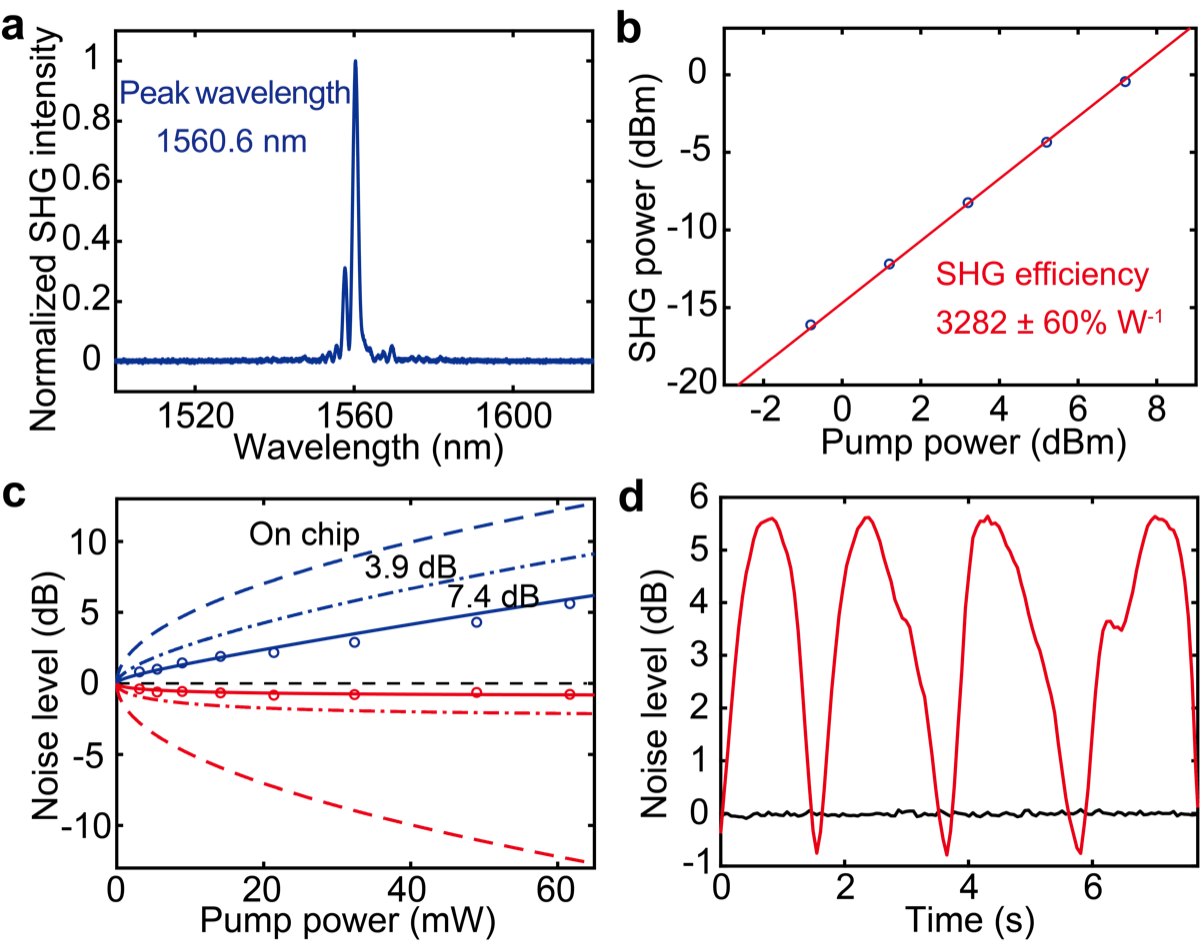
Shi et al. (2025): 7.4 dB on-chip squeezing in TFLN
Shi et al. demonstrated 7.4 dB of on-chip squeezing (1.4 dB measured after coupling losses) from a single-pass TFLN waveguide – no cavity required. This is a landmark result: it shows that waveguide confinement alone can produce parametric gain comparable to cavity-enhanced bulk-crystal systems.
Key achievements:
- SHG efficiency: 3,282%/W in a 5 mm TFLN waveguide – among the highest reported
- Single-pass squeezing: No optical cavity needed; the high normalized efficiency provides sufficient gain in a single pass
- Low coupling loss: SU8 polymer mode-size converters reduced fiber-chip coupling to ~3 dB per facet
- Broadband operation: The squeezed bandwidth (half-width at half-maximum ~6.3 THz) far exceeds the ~MHz bandwidth of cavity-based squeezers
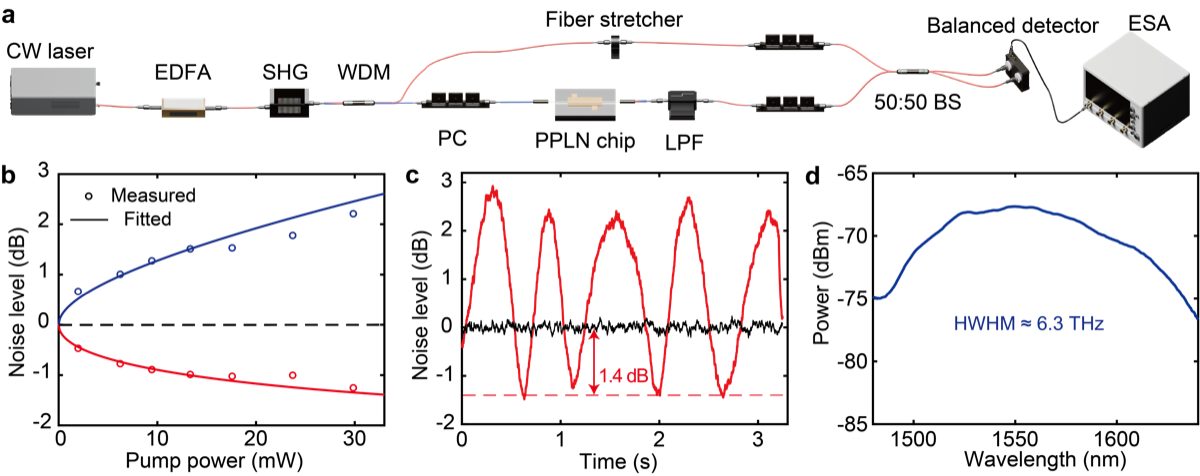
Why 7.4 dB on-chip but only 1.4 dB detected?
The gap between on-chip squeezing and detected squeezing is entirely due to optical loss between the waveguide and the detector. Squeezed states are extraordinarily fragile – any photon lost from the squeezed beam is replaced by an ordinary vacuum fluctuation, degrading the quantum correlations.
The detected squeezing relates to the generated squeezing through:
\[S_\text{det} = \eta \cdot S_\text{gen} + (1 - \eta)\]where $\eta$ is the total optical efficiency (transmission from waveguide to detector) and $S_\text{gen} = e^{-2r}$ is the generated squeezing level. For the Shi et al. result:
- Generated: $e^{-2r} = 10^{-7.4/10} = 0.18$ (7.4 dB)
- Total efficiency: $\eta \approx 0.25$ (dominated by ~3 dB fiber-chip coupling loss per facet)
- Detected: $0.25 \times 0.18 + 0.75 = 0.80$ (about 1.0 dB)
The measured 1.4 dB is consistent with this loss budget. Reducing coupling loss is the single most important challenge for making waveguide squeezers practical. Every 0.5 dB of coupling loss recovered translates directly into more usable squeezing.
Kashiwazaki et al. (2020–2024): PPLN waveguide squeezing
The NTT group in Japan has pursued a parallel approach using periodically poled lithium niobate (PPLN) fiber-pigtailed waveguides – not TFLN, but conventional diffused waveguides with lower confinement. Their results include 6+ dB of directly detected squeezing from a waveguide OPO, demonstrating that waveguide-based squeezing can approach bulk-crystal performance even with weaker confinement.
Quantum photonic circuits: beyond squeezing
A waveguide OPA is more than a compact squeezer – it is a building block for integrated quantum photonic circuits. The same TFLN platform that generates squeezed vacuum can host beam splitters, phase shifters, electro-optic modulators, and photon-number-resolving detectors on a single chip. This opens a path from tabletop quantum optics to photonic-chip quantum optics.
From Gaussian to non-Gaussian states on a chip
Squeezed states are Gaussian – their Wigner function is a Gaussian ellipse. For certain measurement tasks, non-Gaussian states (photon-subtracted, cat states, GKP states) can outperform any Gaussian state. The standard preparation route is photon subtraction: tap a small fraction of a squeezed beam with a beamsplitter, detect one photon in the tap, and the remaining beam is projected into a non-Gaussian state.
Doing this with a bulk-crystal OPO is possible but cumbersome – it requires free-space optics, careful mode matching, and the squeezed bandwidth is limited by the OPO cavity linewidth (typically MHz). A waveguide OPA changes the picture:
- Broadband squeezed source: Single-pass waveguide OPAs produce squeezed light with THz-scale bandwidth, giving access to ultrashort temporal modes
- On-chip beam splitter: A directional coupler etched into the same TFLN chip can tap the squeezed beam with precisely controlled splitting ratio
- Integrated detection: On-chip superconducting nanowire single-photon detectors (SNSPDs) or transition-edge sensors can herald the photon subtraction event
- Programmable circuits: Cascading multiple waveguide OPAs, beam splitters, and phase shifters creates a programmable quantum photonic processor
Why on-chip non-Gaussian states matter for GW detection
Gaussian squeezing faces a fundamental ceiling: it can reduce noise in one quadrature, but the improvement scales only linearly with squeezing strength, and optical losses degrade squeezed states rapidly. Non-Gaussian states like cat states and GKP states can, in principle, provide error-correctable quantum advantages – tolerating moderate losses while still outperforming classical limits.
The practical barrier has been preparation complexity: generating photon-subtracted squeezed states requires delicate tabletop setups with low success rates. If waveguide circuits could generate these states on-chip with high fidelity and repetition rate, it would bring non-Gaussian quantum enhancement from a theoretical possibility to a practical detector upgrade.
For the full physics of non-Gaussian states in metrology, see the Quantum Control project page.
The vision: integrated quantum-enhanced sensing
The long-term vision is a photonic chip that takes in a classical pump laser and outputs quantum-enhanced light tailored to the measurement task – whether that is squeezed vacuum for broadband noise reduction, entangled beams for EPR-based protocols, or non-Gaussian states for sub-Heisenberg sensing. Each of these requires the same core component: a high-efficiency waveguide OPA integrated with programmable linear optics.
This is why the WOPA project has two parallel tracks: the near-term goal of a compact LIGO squeezer (which requires solving coupling loss and audio-frequency noise) and the longer-term goal of a quantum photonic circuit platform (which additionally requires on-chip detection and programmable interferometry).
Competing approaches
Bulk-crystal OPO (current LIGO approach)
PPKTP crystals in bow-tie cavities produce 10–15 dB of squeezing before losses. After propagation through the LIGO interferometer, the effective squeezing is ~6 dB. This is the mature, deployed technology. Advantages: high raw squeezing, well-understood noise properties, decades of engineering. Disadvantages: alignment-sensitive, occupies a full optical table, requires dedicated pump laser and frequency doubler, cannot be easily replicated for multi-detector networks.
Fiber-based squeezing
Optical fibers have $\chi^{(3)}$ nonlinearity (Kerr effect) that can produce squeezing via four-wave mixing. Advantages: all-fiber systems with no free-space alignment. Disadvantages: $\chi^{(3)}$ is intrinsically weaker than $\chi^{(2)}$, requiring higher powers; guided acoustic wave Brillouin scattering (GAWBS) adds phase noise that limits squeezing at audio frequencies – precisely the band most important for GW detection.
Silicon nitride microresonators
Si$_3$N$_4$ ring resonators exploit the Kerr nonlinearity in an integrated platform. Recent demonstrations have produced squeezed frequency combs. Advantages: CMOS-compatible fabrication, very high Q factors (>10$^6$). Disadvantages: $\chi^{(3)}$ process requires higher threshold powers; no electro-optic tuning; thermal bistability complicates operation.
Aluminum nitride / gallium arsenide waveguides
Alternative $\chi^{(2)}$ platforms with different trade-offs. AlN has moderate nonlinearity but excellent CMOS compatibility. GaAs/AlGaAs has very high nonlinearity but absorption near 1 µm limits operation at standard GW wavelengths. Neither platform has the fabrication maturity of TFLN.
Technical challenges
Coupling loss: the critical bottleneck
Squeezed states are destroyed by optical loss. Every photon lost from the squeezed beam is replaced by an ordinary vacuum fluctuation. The relationship is unforgiving:
\[S_\text{measured} = \eta \cdot S_\text{generated} + (1 - \eta)\]For 10 dB of usable squeezing ($S = 0.1$), total efficiency must exceed ~90%. Current TFLN fiber-chip coupling losses of ~1–3 dB per facet (20–50% loss) are far too high. The path forward includes:
- Inverse taper mode converters: Gradually expand the waveguide mode to match the fiber mode, reducing coupling loss to <0.5 dB per facet
- SU8 polymer cladding: The Shi et al. approach uses SU8 polymer spot-size converters to bridge the mode-size mismatch
- Photonic wire bonding: Direct 3D-printed waveguide connections between chip and fiber, demonstrated at <0.5 dB loss
- On-chip integration: Eliminating the fiber-chip interface entirely by integrating the homodyne detector on the same chip
Thermal stability
Lithium niobate has a large thermo-optic coefficient ($dn/dT \approx 4 \times 10^{-5}$ K$^{-1}$), making the phase-matching condition temperature-sensitive. For a 5 mm waveguide, the phase-matching bandwidth in temperature is ~5–10 degrees C. This is manageable with standard thermoelectric controllers, but becomes more demanding for longer waveguides or cavity-enhanced configurations.
Photorefractive damage
Lithium niobate suffers from photorefractive damage at visible and near-visible wavelengths – photogenerated carriers create space-charge fields that modulate the refractive index. This is a concern for the pump beam at 532 nm (for 1064 nm squeezing) or 780 nm (for 1560 nm squeezing). Mitigation approaches include MgO doping (standard in modern PPLN), operating at elevated temperatures, and using congruent-composition crystals with reduced photorefractivity.
Scaling to 2 µm for LIGO Voyager
LIGO Voyager will operate at ~2 µm wavelength. Squeezing at 2 µm requires PDC pumped at ~1 µm, where TFLN phase-matching properties differ significantly. The waveguide geometry must be redesigned, and the periodic poling period changes. This wavelength regime is largely unexplored for TFLN squeezing, representing both a challenge and an opportunity.
Frequency-dependent squeezing context
Simple (frequency-independent) squeezing reduces noise in one quadrature at all frequencies. But gravitational-wave detectors face shot noise at high frequencies (requiring phase-quadrature squeezing) and radiation pressure noise at low frequencies (requiring amplitude-quadrature squeezing). The optimal squeezing angle rotates with frequency.
LIGO’s current solution is a 300-meter filter cavity that imparts this frequency-dependent rotation. McCuller, Dwyer, Green, Yu et al. (2021) developed the theoretical framework for understanding LIGO’s quantum response to squeezed states, and the O4 deployment demonstrated the full system.
Could waveguide squeezers enable a different approach to frequency-dependent squeezing?
The 300-meter filter cavity is a significant infrastructure investment. Alternative approaches that could leverage waveguide technology include:
-
Einstein-Podolsky-Rosen (EPR) squeezing: Uses two entangled squeezed beams and conditional measurements to achieve frequency-dependent noise reduction without a filter cavity. Waveguide squeezers could make the two-squeezer configuration practical by dramatically reducing the footprint.
-
Variational readout: Measuring a frequency-dependent combination of the two output quadratures, effectively achieving the same result as frequency-dependent squeezing at the input. This requires broadband squeezing injection – naturally provided by single-pass waveguide sources.
-
On-chip filter cavities: TFLN supports low-loss ring resonators with Q factors exceeding $10^7$. A centimeter-scale ring resonator could in principle provide the same frequency-dependent rotation as a 300-meter free-space cavity – though achieving the required linewidth (~100 Hz) on a chip remains an open challenge.
None of these alternatives has been demonstrated at the level needed for GW detection, but waveguide technology opens design spaces that were previously impractical.
Connections to EGG projects
The waveguide OPA project connects directly to several other research efforts in the group:
Sum Frequency Generation
SFG uses the same PPLN/$\chi^{(2)}$ nonlinearity and the same TFLN platform. The SFG project converts 2 µm signal photons to 700 nm for high-QE detection; the waveguide OPA generates quantum states at the same wavelengths. Both projects share waveguide design expertise, fabrication infrastructure, and the challenge of minimizing coupling losses. A future integrated system could combine squeezer and frequency converter on a single chip.
Quantum Control
The quantum control project develops the theory and protocols for non-Gaussian state metrology -- cat states, GKP states, photon-subtracted squeezed states. Waveguide OPAs are the natural hardware platform for these protocols: broadband squeezed sources with on-chip photon subtraction could generate non-Gaussian states at rates far exceeding what tabletop setups achieve. The WOPA project provides the source; the quantum control project defines what to do with it.
LIGO Voyager
Voyager's shift to 2 µm wavelength and cryogenic silicon optics creates a need for squeezed light at a new wavelength. Waveguide squeezers at 2 µm would be more compact and potentially more reliable than bulk-crystal alternatives -- important for a cryogenic system where every optical component adds thermal load and alignment complexity.
Phase-Sensitive Optomechanical Amplifier (PSOMA)
PSOMA amplifies the gravitational-wave signal before the lossy readout chain, making downstream optical losses irrelevant. Both PSOMA and waveguide squeezing address the same fundamental problem -- quantum noise -- from complementary directions: squeezing reduces the noise floor, while PSOMA raises the signal above it. A future detector could combine a compact waveguide squeezer at the input with PSOMA at the output for maximum quantum advantage.
Our contributions
-
Frequency-dependent squeezing in LIGO (Ganapathy, Jia, Nakano, Xu, Aritomi et al. 2023) – Demonstrated broadband quantum enhancement of both LIGO detectors with frequency-dependent squeezing, reducing noise by up to 4.0 dB and increasing detection range by 15–18%. This is the deployed system that waveguide squeezers aim to miniaturize.
-
Quantum response to squeezed states (McCuller, Dwyer, Green, Yu et al. 2021) – Developed the theoretical and experimental framework for understanding how LIGO responds to injected squeezed light, including the interplay between squeezing angle, optical losses, and detector configuration. This work defines the performance targets that any replacement squeezer must meet.
-
Cryogenic silicon interferometer design (Adhikari, Arai, Brooks, Wipf et al. 2020) – The LIGO Voyager conceptual design that establishes the 2 µm operating wavelength, motivating development of squeezing technology at wavelengths beyond the current 1064 nm.
-
Optimizing detector design for squeezed light (Richardson, Pandey, Bytyqi, Edo, Adhikari 2022) – Analyzed how detector parameters (arm length, mirror mass, laser power) should be co-optimized with squeezing level to maximize astrophysical sensitivity, establishing design rules for third-generation detectors where waveguide squeezers could be deployed.
Current status and future directions
Current status: We are developing TFLN waveguide OPAs targeting two parallel objectives. The compact squeezer track focuses on demonstrating squeezed vacuum generation at 1064 nm (for current LIGO) and 2 µm (for Voyager), with the engineering challenge of achieving sufficient optical efficiency for detector-grade squeezing. The quantum photonic circuit track explores waveguide OPAs as building blocks in integrated quantum optical systems – combining on-chip squeezed light generation with linear optics and detection for non-Gaussian state preparation.
Near-term goals:
- Fiber-chip coupling below 1 dB: Using inverse taper mode converters and SU8 polymer cladding to bridge the mode-size mismatch between TFLN waveguides (~1 µm) and optical fibers (~10 µm)
- Squeezing at 1064 nm: Demonstrating squeezed vacuum generation at the LIGO operating wavelength from a TFLN waveguide
- Audio-frequency characterization: Measuring the squeezing spectrum from 10 Hz to 10 kHz – the band relevant for GW detection – to identify any technical noise sources (guided acoustic wave scattering, thermo-refractive noise)
- On-chip photon subtraction: Demonstrating heralded photon subtraction from a waveguide squeezed source using integrated directional couplers and single-photon detectors
Open questions:
- Loss budget closure: Can total optical efficiency (coupling + propagation + detection) reach the >90% needed for 10 dB of usable squeezing?
- Audio-frequency noise: Do TFLN waveguides introduce excess noise at 10–100 Hz from guided acoustic modes, thermal fluctuations, or photorefractivity?
- Reliability: PPLN crystals in LIGO run continuously for months during observing runs. Can TFLN waveguides maintain performance over similar timescales?
- 2 µm operation: Can the TFLN platform be adapted for squeezing at 2 µm, where phase-matching and material properties differ significantly?
- Circuit complexity: How many optical components (OPAs, beam splitters, phase shifters, detectors) can be integrated on a single TFLN chip while maintaining quantum-grade loss budgets?
Key references
Waveguide squeezing demonstrations
- Shi et al., “On-chip squeezed light generation in thin-film lithium niobate,” arXiv:2508.08599 (2025). arXiv – 7.4 dB on-chip squeezing from single-pass TFLN waveguide; 3,282%/W SHG efficiency.
- Kashiwazaki et al., “Continuous-wave 6-dB-squeezed light with 2.5-THz-bandwidth from single-mode PPLN waveguide,” APL Photon. 5, 036104 (2020). DOI:10.1063/1.5142437 – 6 dB squeezing from fiber-pigtailed PPLN waveguide OPO.
- Nehra et al., “Few-cycle vacuum squeezing in nanophotonics,” Science 377, 1333 (2022). DOI:10.1126/science.abo6213 – Ultrabroadband squeezing from TFLN nanophotonic waveguide.
TFLN photonics platform
- Wang et al., “Ultrahigh-efficiency wavelength conversion in nanophotonic periodically poled lithium niobate waveguides,” Optica 5, 1438 (2018). DOI:10.1364/OPTICA.5.001438 – 2,600%/W$\cdot$cm$^2$ in nanophotonic PPLN.
- Zhu et al., “Integrated photonics on thin-film lithium niobate,” Adv. Opt. Photon. 13, 242 (2021). DOI:10.1364/AOP.411024 – Comprehensive review of the TFLN platform.
Quantum photonic circuits
- Arrazola et al., “Quantum circuits with many photons on a programmable nanophotonic chip,” Nature 591, 54 (2021). DOI:10.1038/s41586-021-03202-1 – Programmable photonic quantum processor demonstrating non-Gaussian state generation.
- Madsen et al., “Quantum computational advantage with a programmable photonic processor,” Nature 606, 75 (2022). DOI:10.1038/s41586-022-04725-x – Photonic quantum computing with squeezed light inputs.
LIGO squeezing (EGG contributions)
- Ganapathy, Jia, Nakano, Xu, Aritomi et al., “Broadband Quantum Enhancement of the LIGO Detectors with Frequency-Dependent Squeezing,” Phys. Rev. X 13, 041021 (2023).
- McCuller, Dwyer, Green, Yu et al., “LIGO’s quantum response to squeezed states,” Phys. Rev. D 104, 062006 (2021).
- Adhikari, Arai, Brooks, Wipf et al., “A Cryogenic Silicon Interferometer for Gravitational-wave Detection,” CQG 37, 165003 (2020).
- Richardson, Pandey, Bytyqi, Edo, Adhikari, “Optimizing gravitational-wave detector design for squeezed light,” Phys. Rev. D 105, 102002 (2022).
Foundational squeezing physics
- Caves, “Quantum-mechanical noise in an interferometer,” Phys. Rev. D 23, 1693 (1981). DOI:10.1103/PhysRevD.23.1693 – Original proposal for squeezing in GW detectors.
- Slusher et al., “Observation of squeezed states generated by four-wave mixing in an optical cavity,” PRL 55, 2409 (1985). DOI:10.1103/PhysRevLett.55.2409 – First experimental observation of squeezed light.
- Wu et al., “Generation of squeezed states by parametric down conversion,” PRL 57, 2520 (1986). DOI:10.1103/PhysRevLett.57.2520 – First squeezing from OPO (the approach used in LIGO).
Further reading
- Schnabel, “Squeezed states of light and their applications in laser interferometers,” Phys. Rep. 684, 1 (2017). DOI:10.1016/j.physrep.2017.04.001 – Comprehensive review of squeezing for GW detection.
- Andersen et al., “30 years of squeezed light generation,” Phys. Scr. 91, 053001 (2016). DOI:10.1088/0031-8949/91/5/053001 – Historical overview.
- Boes et al., “Lithium niobate photonics: Unlocking the electromagnetic spectrum,” Science 379, eabj4396 (2023). DOI:10.1126/science.abj4396 – Review of LN photonics including nonlinear and quantum applications.