Vacuum Beam Guide
Build and characterize a long-baseline vacuum beam guide as a quantum link between laboratories for interferometry and quantum networking.
Research area
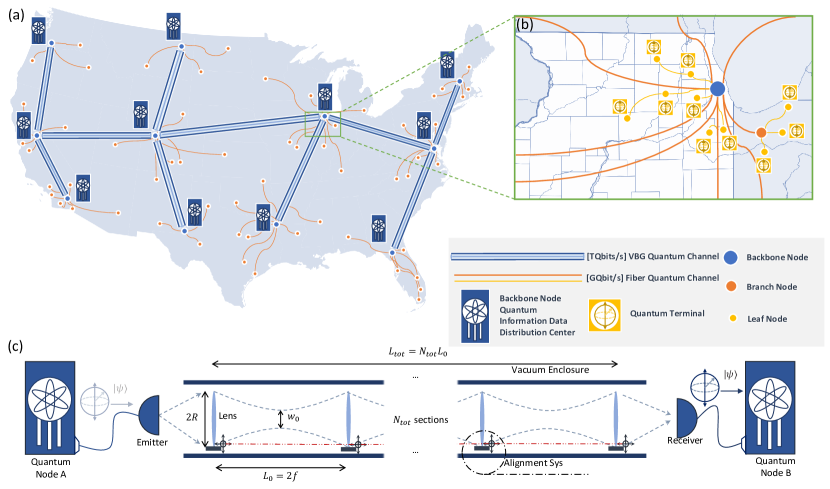
Optical fibers are the backbone of classical telecommunications, but they impose a hard ceiling on quantum communication: at telecom wavelengths, the best fibers lose ~0.16 dB/km, meaning only one in a million photons survives a 300 km link. For quantum networks that cannot amplify without destroying the quantum state, this exponential loss is fatal. The vacuum beam guide (VBG) — an array of lenses inside an evacuated tube — offers a fundamentally different channel: more than an order of magnitude lower attenuation than the best fiber, with broadband wavelength transparency and no need for quantum repeaters.
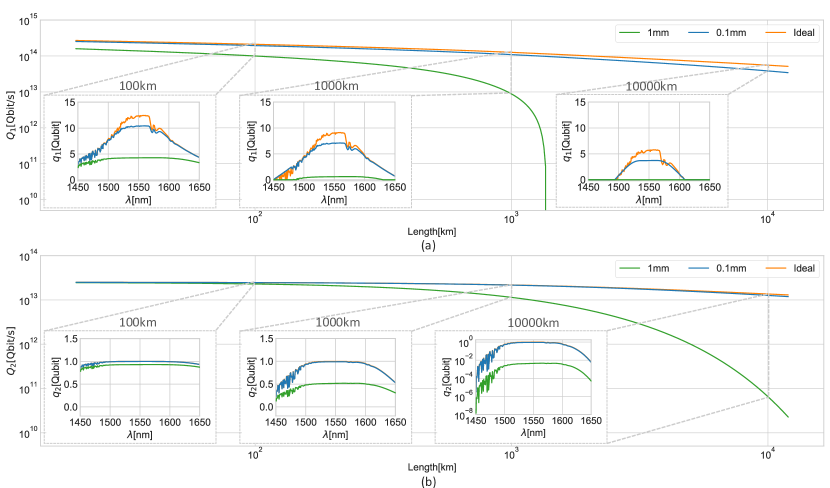
Huang, Salces-Carcoba, Adhikari, Safavi-Naeini & Jiang (2024) showed that a VBG operating at realistic parameters can achieve quantum channel capacities exceeding $10^{13}$ qubits/sec over continental distances — performance completely out of reach for fiber or satellite links.
Contents:
- Gaussian beam propagation in tubes
- Loss mechanisms
- Quantum channel capacity
- Scattered light and phase noise
- Why VBG? Competing approaches
- Engineering requirements
- Applications
- EGG contributions
- Current status and future directions
- Key references
- Further reading
Gaussian beam propagation in tubes
The fundamental physics of a VBG is Gaussian beam propagation through a periodic lens array inside a vacuum enclosure. A Gaussian beam with waist $w_0$ propagates with a Rayleigh range:
\[z_R = \frac{\pi w_0^2 n}{\lambda}\]where $n \approx 1$ in vacuum. Beyond $z_R$, the beam diverges linearly. For a 1064 nm beam with $w_0 = 5$ cm, the Rayleigh range is ~7.4 km — meaning the beam doubles in size over that distance. Over longer paths, diffraction causes the beam to expand until it clips on the tube walls, creating loss.
The critical dimensionless parameter is the Fresnel number:
\[N_F = \frac{a^2}{\lambda L}\]where $a$ is the lens (or tube) radius and $L$ is the spacing between optical elements. When $N_F \gg 1$, diffraction losses are negligible. For $a = 0.5$ m, $L = 1$ km, and $\lambda = 1\;\mu$m: $N_F = 250$. This large Fresnel number is the reason VBGs can achieve such extraordinarily low loss.
Diffraction loss per lens: the Fox-Li analysis
The diffraction loss per stage in a confocal lens waveguide was analyzed by Fox & Li (1961) using iterative Huygens-Fresnel propagation. For the fundamental Gaussian mode in a periodic lens array with Fresnel number $N_F$, the fractional power loss per stage scales as:
\[\alpha_\text{diff} \propto \exp\!\left(-2\pi N_F\right)\]For $N_F = 250$, this gives $\alpha_\text{diff} \sim 10^{-680}$ per stage — effectively zero. Even for much smaller lenses ($a = 10$ cm, giving $N_F = 10$), the diffraction loss is $\sim 10^{-27}$ per stage. Diffraction is not the limiting loss mechanism for any practical VBG design.
The actual loss floor comes from lens surface imperfections, residual gas scattering, and misalignment — all of which are engineering challenges rather than fundamental limits.
Periodic lens waveguide: the ABCD matrix treatment
A single lens-drift stage is described by the ray transfer (ABCD) matrix:
\[M = \begin{pmatrix} 1 & L \\ 0 & 1 \end{pmatrix} \begin{pmatrix} 1 & 0 \\ -1/f & 1 \end{pmatrix}\]where $f$ is the lens focal length. For a stable periodic waveguide, the eigenmode must reproduce itself after each stage. Stability requires $\lvert\text{Tr}(M)/2\rvert < 1$, which gives:
\[0 < L < 4f\]The optimal configuration — minimizing beam size at the lenses — uses $f = L/2$ (confocal spacing). At the midpoint between lenses, the beam waist is:
\[w_0 = \sqrt{\frac{\lambda L}{2\pi}}\]For $L = 1$ km and $\lambda = 1\;\mu$m: $w_0 \approx 1.3$ cm. The beam fits comfortably inside even a modest-diameter tube.
Loss mechanisms
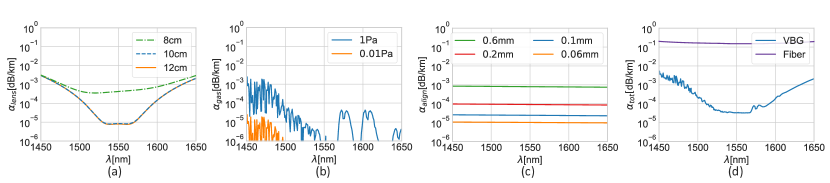
Huang et al. (2024) systematically analyzed the four dominant loss mechanisms in a VBG, finding that the total attenuation can be kept below $10^{-2}$ dB/km with realistic engineering — more than one order of magnitude better than fiber.
1. Lens surface losses
Each lens introduces ~0.1% loss from surface reflection (with anti-reflection coatings) and absorption. Over $N$ lenses across distance $D$ with spacing $L$:
\[\alpha_\text{lens} = \frac{N \times \ell}{D} = \frac{\ell}{L}\]where $\ell$ is the loss per lens. For $\ell = 10^{-3}$ and $L = 1$ km: $\alpha_\text{lens} = 10^{-3}$/km, or $4.3 \times 10^{-3}$ dB/km. This is the dominant loss term and sets the VBG performance floor.
2. Residual gas absorption and scattering
Even in a good vacuum ($\sim 1$ Pa), residual gas molecules scatter and absorb photons. The key advantage of vacuum over air: removing the dominant atmospheric absorbers (H$_2$O, CO$_2$, O$_2$) reduces molecular absorption by orders of magnitude. At 1 Pa, the residual gas (mostly N$_2$ and H$_2$) contributes less than $10^{-5}$ dB/km across the visible and near-IR spectrum.
3. Misalignment
Lateral displacement $\delta$ of a lens from the optical axis couples the fundamental mode into higher-order modes, some of which are lost at subsequent apertures. The misalignment-induced loss per stage scales as:
\[\alpha_\text{mis} \sim \left(\frac{\delta}{w}\right)^2\]where $w$ is the beam radius at the lens. For $w = 5$ cm and $\delta = 1$ mm (achievable with standard surveying alignment), $\alpha_\text{mis} \sim 4 \times 10^{-4}$ per stage.
4. Rayleigh scattering from residual gas
Residual gas molecules Rayleigh-scatter photons out of the beam. The cross-section scales as $\lambda^{-4}$, making this more important at shorter wavelengths. At 1 Pa and visible wavelengths, the contribution is below $10^{-6}$ dB/km — negligible compared to lens losses.
Quantum channel capacity
The practical figure of merit for a quantum communication channel is its quantum channel capacity — the maximum rate at which quantum information (qubits) can be transmitted reliably. For a lossy bosonic channel with transmissivity $\eta$, the one-way quantum capacity is bounded by the Pirandola-Laurenza-Ottaviani-Banchi (PLOB) bound:
\[Q_1 \leq -\log_2(1 - \eta)\]qubits per channel use. For high transmissivity ($\eta \to 1$), $Q_1 \approx \eta/\ln 2$.
Frequency-integrated capacity: why bandwidth matters
A single spatial mode at one frequency gives one channel use per temporal mode. The total quantum capacity integrates over all available frequency channels within the VBG’s transmission window:
\[Q_\text{total} = \int_{\nu_\text{min}}^{\nu_\text{max}} Q_1(\eta(\nu))\, \frac{d\nu}{B_\text{mode}}\]where $B_\text{mode}$ is the bandwidth per temporal mode. Because the VBG is transparent across the entire optical spectrum (unlike fiber, which is restricted to telecom windows), the frequency-integrated capacity is enormously larger.
Huang et al. calculated the frequency-integrated capacity assuming wavelength-division multiplexing across the 400–2000 nm window and found $Q_\text{total} > 10^{13}$ qubits/sec for continental distances (~1000 km) — far exceeding what any fiber-based system can achieve, even with ideal quantum repeaters.
Scattered light and phase noise
For precision interferometry applications — such as linking gravitational-wave detectors or distributing squeezed light — scattered light is a critical noise source beyond simple loss. Photons that scatter off tube walls, baffles, or lens surfaces can re-enter the beam after picking up phase noise from vibrating surfaces. This converts mechanical vibration into optical phase noise, potentially overwhelming the quantum signal.
The scattered light noise power spectral density scales as:
\[S_\phi(f) \propto \sum_i r_i^2 \, S_x^{(i)}(f) \, k^2\]where $r_i$ is the amplitude reflectivity of the $i$-th scattering surface, $S_x^{(i)}(f)$ is its displacement noise spectrum, and $k = 2\pi/\lambda$. The LIGO collaboration has extensive experience managing scattered light — the techniques developed for LIGO’s beam tubes (Soni et al. 2021) directly inform VBG design.
Key mitigation strategies:
- Baffles: Serrated-edge baffles at regular intervals absorb scattered light before it can recombine with the main beam. LIGO uses similar baffles in its 4 km beam tubes.
- Tube surface treatment: Roughened or absorptive inner surfaces prevent specular reflection of scattered light back into the beam path.
- Vacuum quality: Lower pressure means fewer gas molecules to scatter from, reducing both Rayleigh scattering and refractive index fluctuations.
- Vibration isolation: Lens mounts and tube supports must be isolated from seismic and acoustic disturbances to prevent phase modulation of the scattered light.
Refractive index fluctuations
Even in vacuum, statistical fluctuations in the residual gas density cause refractive index noise. The phase noise from this mechanism scales as:
\[S_\phi^\text{gas}(f) \propto \frac{P \, L}{T \, v_\text{flow}} \, \frac{(n-1)^2}{\lambda^2}\]where $P$ is the pressure, $L$ is the path length, $T$ is temperature, and $v_\text{flow}$ is the gas flow velocity. At $10^{-4}$ Pa (UHV conditions), this noise is far below the quantum noise limit for any foreseeable application.
Why VBG? Competing approaches
Optical fiber
The incumbent technology for quantum communication. Telecom fiber at 1550 nm achieves 0.16 dB/km — impressive for classical signals but devastating for quantum states over long distances. At 100 km, only 1% of photons survive. Quantum repeater stations could extend the range, but practical quantum repeaters require quantum memories with millisecond coherence times and high-efficiency entanglement swapping — capabilities that remain at the proof-of-concept stage.
Free-space / satellite links
Satellite quantum key distribution (QKD) has been demonstrated (Micius, 2017) over 1200 km, but with enormous loss (~40 dB in the downlink). The channel is intermittent (clear weather, nighttime, satellite passes), low-bandwidth, and turbulence-limited. Two-way entanglement distribution is extremely challenging due to atmospheric turbulence and diffraction over long paths.
Quantum repeaters
The theoretical solution to fiber loss: divide the channel into short segments, distribute entanglement over each segment, then “swap” entanglement between segments to extend the range. In principle, this allows arbitrary-distance quantum communication. In practice, no quantum repeater has been demonstrated at rates or fidelities useful for practical quantum networking. The leading approaches (atomic ensemble memories, trapped ions, nitrogen-vacancy centers) face decoherence times of milliseconds, entanglement generation rates of Hz, and multi-photon error rates that compound over many segments.
Hollow-core fiber
Hollow-core photonic crystal fibers guide light through air rather than glass, reducing material absorption. State-of-the-art hollow-core fibers achieve ~0.17 dB/km at 1550 nm — comparable to solid-core fiber. The air core eliminates some nonlinear effects but does not solve the fundamental absorption and scattering problem. Achieving the $<10^{-2}$ dB/km of a practical VBG would require significant improvements.
Engineering requirements
Building a practical VBG over hundreds or thousands of kilometers is a major infrastructure project — comparable in scale to a particle accelerator beamline or the LIGO beam tubes. The key engineering challenges are:
Vacuum system
The tube must be evacuated to at least ~1 Pa to suppress atmospheric absorption and turbulence. This is a modest vacuum by physics standards — LIGO’s beam tubes operate at $10^{-7}$ Pa. Large-diameter (>1 m) vacuum tubes over long distances exist: LIGO has 1.2 m diameter tubes spanning 4 km, and the Superconducting Super Collider (cancelled in 1993) had completed 23 km of tunnel before termination.
The vacuum system can use straightforward technology: rough pumping with scroll pumps, followed by turbomolecular or ion pumps for the final vacuum. Outgassing from the tube walls (primarily H$_2$O and H$_2$) is the dominant gas load and can be managed with bakeout and appropriate material selection (stainless steel or aluminum).
Lens alignment and stability
Each lens must be centered on the optical axis to within ~1 mm over the full link length. This is achievable with standard geodetic surveying techniques. Long-term alignment drift from thermal expansion, ground settling, and tectonic motion requires either periodic realignment or active feedback using alignment laser beams co-propagating with the quantum signal.
Thermal management
Temperature gradients along the tube create convective gas flows and refractive index gradients. Burying the tube underground (like LIGO’s beam tubes) provides passive thermal stability. Surface-level installations would require thermal insulation or active temperature control.
Cost and scalability
Cost comparison with existing infrastructure
The cost of a VBG is dominated by the vacuum tube and pumping infrastructure. For comparison:
- LIGO beam tubes: 4 km of 1.2 m diameter stainless steel tube, ~$50M per arm (1990s dollars). This includes ultra-high vacuum ($10^{-7}$ Pa) capability — far beyond what a VBG requires.
- Natural gas pipelines: Large-diameter steel pipelines cost $1–5M per km, including installation and right-of-way. A VBG tube has similar diameter requirements but much less stringent pressure ratings.
- Fiber optic cables: Long-haul fiber installation costs $20–50K per km, including trenching. But fiber requires repeater stations every ~80 km for classical signals, adding significant recurring cost.
A VBG operating at ~1 Pa (versus LIGO’s $10^{-7}$ Pa) needs far simpler vacuum technology. The lens cost (~$10K per lens at 1 km spacing) is a minor contribution. The dominant cost is civil engineering: trenching, tube installation, and pumping stations — comparable to pipeline infrastructure at $1–5M/km.
Applications
Quantum networking between gravitational-wave detectors
A VBG connecting LIGO Hanford and LIGO Livingston (3000 km apart) could distribute entangled light between the two interferometers. This would enable:
- Correlated quantum measurements: Sharing squeezed light between detectors for joint quantum-enhanced observation, improving sensitivity to stochastic gravitational-wave backgrounds.
- Quantum teleportation of measurement outcomes: Transmitting quantum measurement results between sites without classical communication delay.
- Entanglement-based signal verification: Using quantum correlations to distinguish true gravitational-wave signals from local noise artifacts.
This connects directly to EGG’s work on LIGO Voyager and precision optomechanical platforms.
Long-baseline interferometry
A VBG enables interferometric baselines far longer than any single laboratory. For tabletop tests of quantum gravity, extending the baseline increases sensitivity to space-time fluctuations. For geodesy and geophysics, a multi-kilometer optical link provides strain sensitivity competitive with laser ranging.
Distributed quantum computing
Modular quantum computers — each with tens to hundreds of qubits — could be linked by VBGs to form a large-scale distributed quantum processor. The VBG’s low loss preserves the entanglement fidelity needed for distributed quantum error correction, which demands channel losses below a few percent per link.
Fundamental physics
Ultra-low-loss optical channels enable tests of quantum mechanics over macroscopic distances: Bell inequality violations at continental scales, tests of gravitational decoherence models, and searches for exotic physics that might cause loss of quantum coherence over long baselines.
EGG contributions
-
VBG concept and analysis — Huang, Salces-Carcoba, Adhikari, Safavi-Naeini & Jiang (2024) developed the full theoretical framework for vacuum beam guides as quantum channels, analyzing all loss mechanisms and demonstrating more than an order of magnitude improvement over fiber. This paper establishes the VBG as a viable technology for continental-scale quantum networking.
-
Scattered light expertise (Soni, …, Adhikari et al. 2021) — LIGO’s experience with scattered light in 4 km beam tubes directly informs VBG baffle design and surface treatment. The techniques developed for LIGO’s third observing run — identifying, characterizing, and mitigating scattered light noise — are directly transferable to VBG engineering.
-
LIGO Voyager and next-generation detector design (Adhikari et al. 2020) — The LIGO Voyager conceptual design explores the detector network architecture that a VBG would connect. Quantum-enhanced multi-detector correlations require the low-loss channels that only a VBG can provide at inter-site distances.
Current status and future directions
Current status: The VBG concept has been analyzed theoretically, with the Huang et al. (2024) paper establishing the fundamental performance limits and demonstrating feasibility. At Caltech, the EGG group is developing infrastructure for campus-scale optical links between laboratories using evacuated tubes — a prototype VBG that serves as a testbed for the key technologies (alignment, vacuum, scattered light control) at the ~100 m scale.
Near-term goals:
- Demonstrate low-loss beam propagation through an evacuated tube over ~100 m on the Caltech campus
- Characterize scattered light and refractive index noise at relevant frequencies
- Test squeezed light transmission through the prototype link
- Develop alignment and stabilization protocols for unattended operation
Open physics questions:
- Loss floor: What is the achievable total loss per km in a practical VBG? The theoretical limit ($<10^{-2}$ dB/km) is set by lens coatings, but real systems will have additional contributions from alignment drift, lens contamination, and vacuum degradation.
- Phase noise: For interferometric applications, phase stability matters as much as amplitude loss. What is the residual phase noise from gas density fluctuations, thermal expansion, and seismic motion?
- Scaling: Does the lens-by-lens loss accumulate coherently (field amplitudes add) or incoherently (powers add)? Coherent accumulation would create resonance effects in the periodic structure.
- Multi-mode capacity: Can higher-order spatial modes be used for additional quantum channels (spatial-mode multiplexing), or does mode coupling between stages scramble the spatial structure?
- Integration with quantum memories: A complete quantum network needs not just channels but also quantum memories for synchronization and routing. How do VBG channel properties (bandwidth, noise spectrum, loss) match the requirements of leading quantum memory platforms?
Key references
VBG concept and analysis
- Huang, Salces-Carcoba, Adhikari, Safavi-Naeini & Jiang, “Vacuum Beam Guide for Large Scale Quantum Networks,” arXiv:2312.09372 (2024). arXiv — The foundational VBG paper: loss analysis, quantum capacity calculations, and network architecture.
Gaussian beam propagation and lens waveguides
- Fox & Li, “Resonant modes in a maser interferometer,” Bell Syst. Tech. J. 40, 453 (1961). DOI:10.1002/j.1538-7305.1961.tb01625.x — Foundational analysis of diffraction losses in periodic optical structures.
- Siegman, Lasers (University Science Books, 1986), Chapters 15–20. — Comprehensive treatment of Gaussian beam propagation, ABCD matrices, and stable resonator theory.
- Kogelnik & Li, “Laser beams and resonators,” Appl. Opt. 5, 1550 (1966). DOI:10.1364/AO.5.001550 — Classic review of Gaussian beam optics and resonator stability.
Quantum channel capacity
- Pirandola, Laurenza, Ottaviani & Banchi, “Fundamental limits of repeaterless quantum communications,” Nature Commun. 8, 15043 (2017). DOI:10.1038/ncomms15043 — The PLOB bound: ultimate capacity limit for lossy quantum channels.
Quantum networking
- Kimble, “The quantum internet,” Nature 453, 1023 (2008). DOI:10.1038/nature07127 — Vision paper for quantum networks connecting quantum processors, sensors, and memories.
- Wehner, Elkouss & Hanson, “Quantum internet: A vision for the road ahead,” Science 362, eaam9288 (2018). DOI:10.1126/science.aam9288 — Staged development roadmap for quantum networks.
Satellite quantum communication
- Yin et al., “Satellite-based entanglement distribution over 1200 kilometers,” Science 356, 1140 (2017). DOI:10.1126/science.aan3211 — Micius satellite demonstration.
Scattered light in beam tubes
- Soni et al., “Reducing scattered light in LIGO’s third observing run,” CQG 38, 025016 (2021). DOI:10.1088/1361-6382/abc906 — Directly relevant LIGO experience with scattered light in vacuum beam tubes.
GW detector context
- Adhikari et al., “A cryogenic silicon interferometer for gravitational-wave detection,” CQG 37, 165003 (2020). DOI:10.1088/1361-6382/ab9143 — LIGO Voyager design motivating quantum links between detectors.
Further reading
For readers who want to go deeper:
- Siegman, Lasers (University Science Books, 1986) — the definitive textbook for Gaussian beam propagation, resonator stability, and diffraction in periodic structures. Chapters 15–20 are directly relevant to VBG design.
- Pirandola et al., “Advances in quantum cryptography,” Adv. Opt. Photonics 12, 1012 (2020). DOI:10.1364/AOP.361502 — Comprehensive review of quantum key distribution, including channel capacity theory.
- Varnava et al., “All-photonic quantum repeaters,” Phys. Rev. Lett. 116, 250501 (2016). DOI:10.1103/PhysRevLett.116.250501 — A leading quantum repeater proposal that a VBG could eventually complement or replace.