Tabletop tests of quantum gravity
Design tabletop optomechanical experiments that probe quantum aspects of gravity and potential deviations from standard quantum mechanics.
Research area
Gravity is the only fundamental force without a complete quantum description. General relativity governs spacetime geometry at macroscopic scales; quantum mechanics rules the microscopic world. Where these two theories meet — at the Planck scale, $\ell_P = \sqrt{\hbar G/c^3} \approx 1.6 \times 10^{-35}$ m — neither one alone suffices, and no experiment has yet probed their intersection directly. We design laboratory experiments that search for quantum-gravitational signatures using the precision measurement toolkit developed for gravitational-wave detection: ultra-low-noise interferometry, quantum-limited readout, cryogenic isolation, and non-classical states of light and matter.
Contents:
- Why tabletop experiments?
- Spacetime dissipation
- Holographic noise
- Gravitational decoherence
- Gravity-mediated entanglement (BMV proposal)
- Dark matter searches with laser interferometers
- Quantum-enhanced sensing below the standard quantum limit
- Why these approaches? Competing strategies
- Our contributions
- Current status and future directions
- Key references
- Further reading
Why tabletop experiments?
Traditional routes to quantum gravity focus on extreme environments: the Big Bang, black hole singularities, or particle collisions at the Planck energy ($E_P \sim 10^{19}$ GeV — eight orders of magnitude beyond the LHC). These regimes are observationally inaccessible or require extrapolation across enormous energy scales. But there is another path: precision measurement at low energy.
The core insight is dimensional. Quantum gravity effects scale as some power of the ratio $E/E_P$ or $\ell_P/L$, where $L$ is the experimental length scale. For a single particle, these corrections are hopelessly small. But collective systems — kilogram-scale mirrors, high-finesse cavities with $10^{19}$ photons per second, or mechanical oscillators prepared in non-classical states — can accumulate tiny effects to measurable levels through:
-
Long integration times. A displacement noise $\sqrt{S_x} \sim \ell_P$ at 100 Hz, integrated over $10^7$ seconds of observation, produces a statistically significant signal if the detector noise floor is comparable. LIGO-class instruments already achieve $\sqrt{S_x} \sim 10^{-20}$ m/$\sqrt{\text{Hz}}$.
-
Quantum amplification. Preparing a mechanical system in a squeezed or entangled state increases its sensitivity to decoherence from external sources — including any decoherence caused by gravity. The sensitivity improvement scales with the degree of squeezing, making quantum state preparation an enabling technology.
-
Null experiments. Some quantum gravity predictions involve qualitatively new effects — anomalous correlations between interferometer arms, frequency-dependent excess noise, decoherence faster than predicted by standard quantum mechanics. These are null tests: standard physics predicts zero, so any nonzero result is new.
The key advantage of laboratory experiments over astrophysical tests is control. We choose the experimental geometry, the quantum state of the probe, the readout strategy, and the integration time. We can run null tests, swap components, change arm lengths, and repeat the measurement. Astrophysical observations — black hole ringdowns, primordial gravitational waves — provide one-shot data from systems we cannot manipulate.
Spacetime dissipation
If gravity is an emergent phenomenon — arising from underlying microscopic degrees of freedom, much as fluid dynamics emerges from molecular interactions — then the effective macroscopic theory should exhibit dissipation. Just as viscosity arises from the molecular structure of fluids, spacetime dissipation would arise from the granular microstructure of quantum gravity.
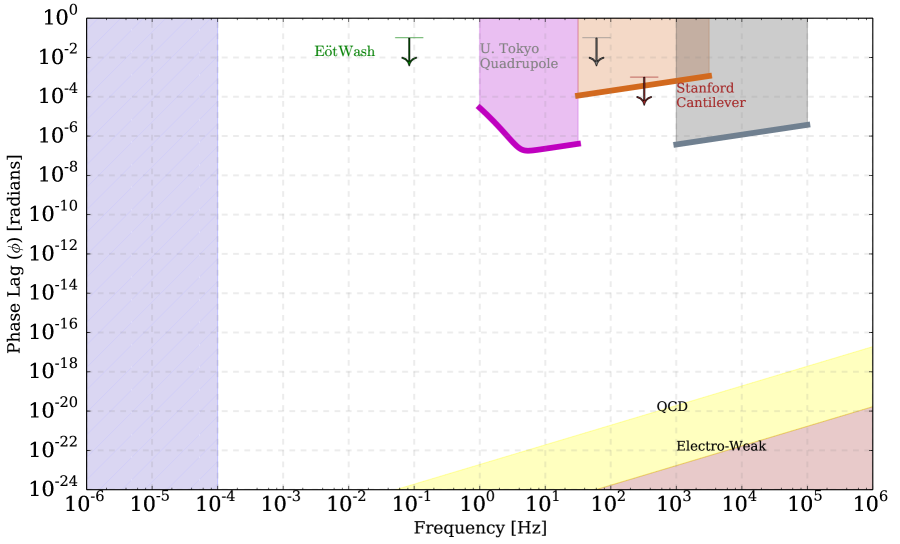
Yang, Price, Smith, Adhikari, Miao & Chen (2015) developed a phenomenological framework for laboratory searches for spacetime dissipation, modeling the effect as frequency-dependent corrections to the displacement noise spectrum of an interferometer.
The phenomenological model
The dissipation framework introduces a complex correction to the gravitational response. In the Newtonian limit, the static potential between two masses is $V(r) = -Gm_1 m_2/r$. In the dissipative extension, the frequency-domain response of a mechanical oscillator to a gravitational drive acquires an imaginary part:
\[\chi(\omega) = \frac{1}{m(\omega_0^2 - \omega^2 + i\gamma_\text{grav}\omega)}\]where $\gamma_\text{grav}$ is the gravitational dissipation rate. Standard general relativity predicts $\gamma_\text{grav} = 0$; any nonzero value indicates new physics. The challenge is distinguishing $\gamma_\text{grav}$ from mundane dissipation — gas damping, clamping losses, thermoelastic friction — which also produce imaginary parts in the mechanical response.
Why dissipation implies fluctuation noise
The fluctuation-dissipation theorem guarantees that any dissipative mechanism is accompanied by a fluctuating force. If spacetime has a dissipation rate $\gamma_\text{grav}$ at temperature $T_\text{eff}$, then the associated force noise power spectral density is:
\[S_F(\omega) = 4 k_B T_\text{eff} \, m \gamma_\text{grav}\]This produces a displacement noise:
\[S_x(\omega) = \frac{S_F}{m^2 |\omega_0^2 - \omega^2|^2} = \frac{4 k_B T_\text{eff} \gamma_\text{grav}}{m |\omega_0^2 - \omega^2|^2}\]At frequencies below the mechanical resonance ($\omega \ll \omega_0$), this noise is frequency-independent (white). At frequencies above resonance, it falls as $\omega^{-4}$. The key point: the effective temperature $T_\text{eff}$ need not be the physical temperature of the apparatus — it could be the Planck temperature ($T_P \sim 10^{32}$ K) or some intermediate scale determined by the quantum gravity theory.
Experimental strategies
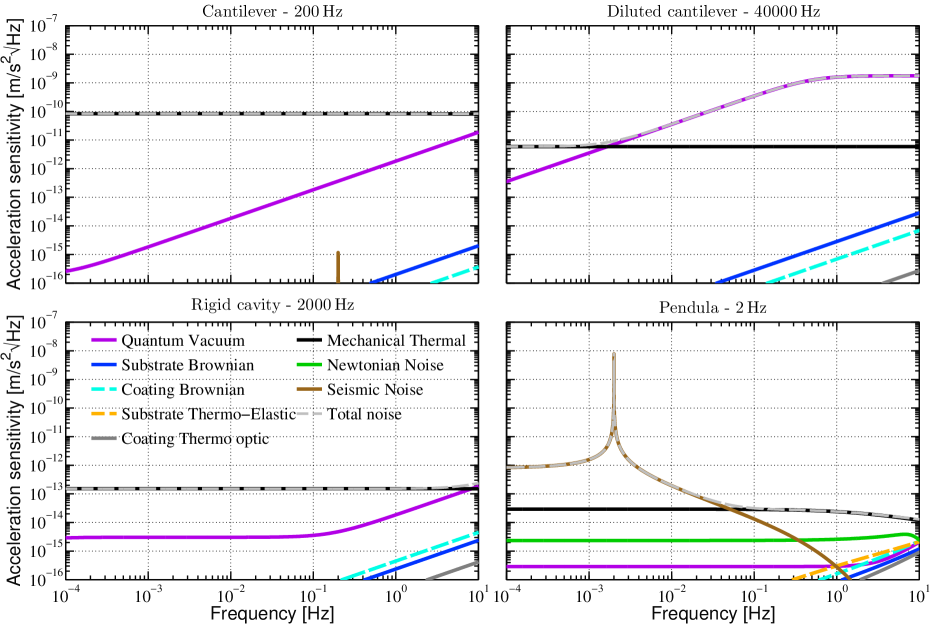
Yang et al. analyzed four detector configurations — cantilever (200 Hz), diluted cantilever (40 kHz), rigid cavity (2 kHz), and pendulum (2 Hz) — and computed detailed noise budgets for each. The analysis showed that pendulum-based detectors at low frequencies (0.01–1 Hz) offer the best sensitivity to gravitational dissipation, because:
- Mechanical thermal noise falls as $1/Q$, and pendula achieve $Q > 10^8$ through dilution.
- Seismic noise can be suppressed by multi-stage isolation (as in LIGO suspensions).
- Quantum vacuum noise is the dominant limit at low mass, but kilogram-scale test masses push this floor down.
The fundamental tradeoff is between mechanical quality factor ($Q$), test mass ($m$), and readout sensitivity. Larger $Q$ suppresses thermal noise; larger $m$ suppresses quantum noise; better readout (e.g., squeezed light) suppresses shot noise. All three must be simultaneously optimized.
Holographic noise
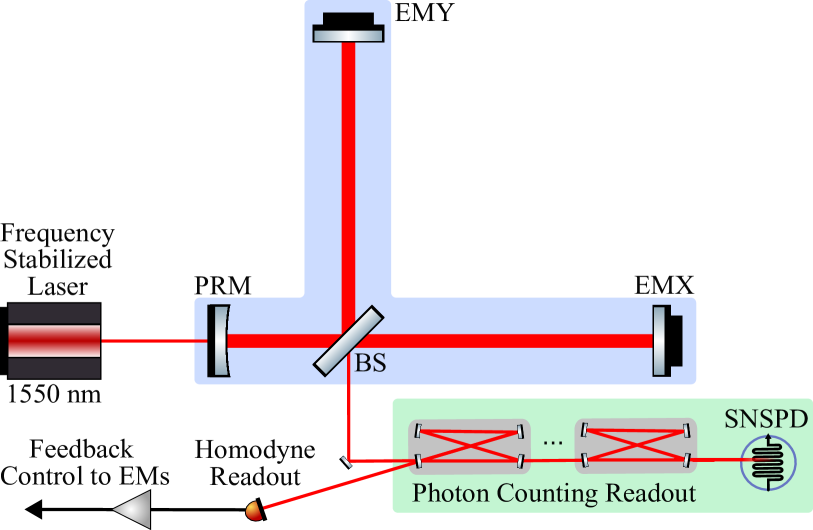
Some approaches to quantum gravity — notably string-theoretic holographic models and causal set theory — predict that spacetime has a discrete microstructure at or near the Planck scale, producing measurable phase fluctuations in laser interferometers.
Verlinde & Zurek (2021) developed a theoretical framework predicting “geontropic” fluctuations: spacetime noise arising from the entanglement structure of the vacuum, with a displacement noise spectral density that scales as $S_x(f) \sim \ell_P \cdot L / c$ where $L$ is the interferometer arm length. The signal peaks at frequencies corresponding to the light travel time across the instrument, typically in the MHz range for meter-scale arms.
The Holometer experiment at Fermilab (Chou et al., 2017) searched for correlated holographic noise between two co-located 40-meter interferometers and set null bounds on a specific class of models. Next-generation experiments, including GQuEST (Vermeulen et al., 2024) and the work of the McCuller group on photon-counting readout for holographic noise searches (McCuller et al., 2024), aim to probe a broader class of holographic models using cross-correlation and non-classical readout strategies.
Gravitational decoherence
Standard quantum mechanics predicts that isolated quantum systems maintain coherence indefinitely. But several theoretical frameworks — the Diosi-Penrose model, continuous spontaneous localization (CSL), and various gravitational decoherence proposals — predict that gravity causes massive quantum superpositions to collapse at a rate that depends on the mass, the spatial extent of the superposition, and the gravitational self-energy.
The Diosi-Penrose model
The most concrete prediction comes from Diosi (1989) and Penrose (1996), who independently proposed that a spatial superposition of a massive object decoheres at a rate set by the gravitational self-energy difference between the two branches:
\[\tau_\text{DP}^{-1} = \frac{\Delta E_\text{grav}}{\hbar} = \frac{G}{\hbar} \int \frac{[\rho_1(\mathbf{r}) - \rho_2(\mathbf{r})][\rho_1(\mathbf{r}') - \rho_2(\mathbf{r}')]}{|\mathbf{r} - \mathbf{r}'|} \, d^3r \, d^3r'\]where $\rho_1$ and $\rho_2$ are the mass density distributions in the two superposition branches. For a solid sphere of mass $m$ and radius $R$ displaced by its own diameter, this gives $\tau_\text{DP} \sim \hbar R / (Gm^2)$. For a nanogram-scale sphere ($m \sim 10^{-12}$ kg, $R \sim 5\,\mu$m), $\tau_\text{DP} \sim 1$ s — potentially observable if the sphere can be prepared in a spatial superposition and read out on timescales shorter than conventional decoherence. For milligram-scale masses, $\tau_\text{DP}$ drops to sub-femtosecond timescales, far too fast to observe directly.
CSL and other collapse models
Continuous spontaneous localization (CSL) is a phenomenological modification of quantum mechanics that adds a stochastic, nonlinear term to the Schrodinger equation. The collapse rate scales with the number of nucleons in the system, parameterized by two constants: $\lambda$ (the collapse rate per nucleon) and $r_C$ (the correlation length). The original Ghirardi-Rimini-Weber (GRW) values are $\lambda = 10^{-16}$ s$^{-1}$ and $r_C = 10^{-7}$ m, but these are not uniquely predicted by any fundamental theory.
CSL predicts a diffusive heating of mechanical oscillators — the collapse field continuously imparts momentum kicks to the center of mass. The excess heating rate is:
\[\dot{\bar{E}}_\text{CSL} = \frac{3\lambda \hbar^2}{4m_0 r_C^2} \left(\frac{m}{m_0}\right) \approx \frac{3\lambda \hbar^2 N}{4m_0 r_C^2}\]where $m_0$ is the nucleon mass and $N$ is the number of nucleons. For a sub-nanogram oscillator with $N \sim 10^{14}$, this heating is potentially detectable by cryogenic mechanical experiments — provided thermal noise can be suppressed to comparable levels.
Current experimental bounds on CSL come from LIGO (Carlesso et al. 2016), cold-atom interferometry (Kovachy et al. 2015), and cryogenic cantilevers (Vinante et al. 2020). Together, these have excluded the GRW parameters and pushed $\lambda$ below $\sim 10^{-10}$ s$^{-1}$ at $r_C = 10^{-7}$ m.
Experimental requirements
Testing gravitational decoherence requires preparing massive objects in well-defined quantum superpositions and measuring the coherence as a function of time, mass, and superposition size. The key technical challenges are:
-
State preparation. Creating a spatial superposition of a massive object requires either free evolution from a momentum-squeezed state (expand the wavefunction to macroscopic size, then interfere) or optomechanical entanglement with a photonic degree of freedom. Our quantum control and precision optomechanical platforms projects develop both capabilities.
-
Environmental isolation. At the target mass scale ($\mu$g to mg), conventional decoherence from gas collisions, blackbody radiation, and electromagnetic noise overwhelms the predicted gravitational decoherence by many orders of magnitude. Ultra-high vacuum ($< 10^{-12}$ mbar), cryogenic temperatures (< 10 mK), and electromagnetic shielding are all necessary.
-
Readout. The superposition must be measured with single-quantum sensitivity to distinguish gravitational decoherence from technical noise. This motivates the development of quantum-limited optomechanical readout and phase-sensitive amplification.
Gravity-mediated entanglement (BMV proposal)
In 2017, Bose, Marletto & Vedral (BMV) proposed a striking experiment: if two massive particles, each prepared in a spatial superposition, become entangled solely through their gravitational interaction, this would constitute evidence that gravity can transmit quantum information — and therefore must itself be quantized.
The experimental concept
Two particles of mass $m$, separated by distance $d$, are each placed in a superposition of two positions (left and right of center). The gravitational potential between them depends on their relative positions: when both are on the near sides, the attraction is stronger ($d - \Delta x$); when on the far sides, it is weaker ($d + \Delta x$). Over time $T$, this differential phase accumulates:
\[\Delta\phi = \frac{Gm^2 T}{\hbar} \left(\frac{1}{d - \Delta x} - \frac{1}{d + \Delta x}\right) \approx \frac{2Gm^2 T \Delta x}{\hbar d^2}\]If $\Delta\phi$ is nonzero, the two particles become entangled — their joint state cannot be written as a product of individual states. Measuring this entanglement (via coincidence measurements after recombination) would demonstrate that gravity transmits quantum correlations.
Why entanglement implies quantized gravity
The argument, due to Marletto & Vedral (2017), uses a theorem from quantum information: a classical channel cannot generate entanglement between quantum systems. If gravity is fundamentally classical — a background field described by a real-valued metric with no quantum degrees of freedom — then gravitational interaction between two quantum systems is a classical channel. A classical channel can correlate the systems but cannot entangle them.
Therefore, if the experiment observes entanglement, at least one of the following must be true:
- Gravity has quantum degrees of freedom (i.e., the graviton exists).
- There is a non-gravitational quantum interaction mimicking the gravitational effect (e.g., Casimir forces, electromagnetic coupling).
- The theorem does not apply (i.e., the “locality loophole” — the interaction is non-local).
Careful experimental design must close option (2) by shielding electromagnetic interactions and demonstrating that the coupling scales as $Gm^2$ rather than electromagnetically. Option (3) is a genuine theoretical subtlety that continues to be debated.
Experimental challenges
The BMV experiment requires:
-
Superposition of massive particles. The entanglement phase scales as $m^2$, so heavier particles produce larger signals. But creating spatial superpositions is harder for more massive objects. Current proposals target diamond microspheres with nitrogen-vacancy (NV) center spins, using magnetic field gradients to create spin-dependent trajectories: $m \sim 10^{-14}$ kg, $\Delta x \sim 100$ $\mu$m.
-
Sufficient gravitational phase. For the NV-center scheme with $m = 10^{-14}$ kg, $d = 200$ $\mu$m, $\Delta x = 100$ $\mu$m, and $T = 1$ s: $\Delta\phi \sim 0.3$ rad (using the exact formula; the linearized approximation is poor here since $\Delta x / d = 0.5$). This is a large phase, but achieving it demands coherence times of order seconds — far beyond current achievements with massive particles. More conservative parameters ($m = 10^{-14}$ kg, $d = 500\,\mu$m, $\Delta x = 25\,\mu$m, $T = 1$ s) give $\Delta\phi \sim 10^{-3}$ rad.
-
Suppression of competing interactions. Casimir-Polder forces between the particles at 200 $\mu$m separation can exceed the gravitational coupling. Electromagnetic shielding and careful geometry are essential. The experiment must demonstrate that any observed entanglement scales as expected for gravity ($\propto m^2$) and not for electromagnetic forces.
Dark matter searches with laser interferometers
Gravitational-wave detectors are exquisitely sensitive to tiny displacements of their test masses. If dark matter consists of macroscopic compact objects — as proposed in some models — these objects would gravitationally deflect LIGO’s mirrors as they pass through the detector, producing transient signals distinct from gravitational waves.
Hall, Adhikari, Frolov, Müller & Pospelov (2018) analyzed the detectability of macroscopic dark matter with current and future gravitational-wave observatories. The key insight: a compact dark-matter object of mass $M_\text{DM}$ passing at distance $b$ from a LIGO test mass produces a gravitational impulse:
\[\Delta v \sim \frac{2GM_\text{DM}}{bv_\text{DM}}\]where $v_\text{DM} \sim 10^{-3}c$ is the characteristic dark matter velocity in the galactic halo. The resulting test-mass displacement is a transient “glitch” with a characteristic time profile (fast rise, slow decay) set by the geometry of the flyby.
Event rates and mass reach
The event rate depends on the local dark matter density ($\rho_\text{DM} \approx 0.4$ GeV/cm$^3$), the mass of the individual dark matter objects ($M_\text{DM}$), the detector cross-section, and the velocity distribution. Hall et al. computed that:
-
LIGO: Sensitive to $M_\text{DM} \sim 10^{-3}$ – $10^3$ kg (roughly milligram to metric ton). The event rate for favorable masses is $\sim 1$ per year per detector.
-
LISA: The much larger baseline ($\sim 10^6$ km) and lower frequency band make LISA sensitive to $M_\text{DM} \sim 10^5$ – $10^{15}$ kg. For masses of $\sim 10^{10}$ kg (asteroid-scale), event rates could be $\sim 1$ per 10 years.
-
Signal discrimination: Dark matter transients are distinguishable from gravitational waves by their impulsive time profile and their characteristic dependence on impact parameter. The signal produces a non-quadrupolar response pattern (unlike gravitational waves, which couple equally and oppositely to the two arms), providing a powerful discriminant through multi-arm analysis.
The analysis assumed a monochromatic mass spectrum (all dark matter in objects of a single mass). Extending to broad mass distributions requires convolving the sensitivity with a mass function — Hall et al. provided the framework for this generalization.
This work connects directly to our computational experiment design efforts, where optimization techniques can be applied to design detector configurations with maximal dark-matter sensitivity.
Quantum-enhanced sensing below the standard quantum limit
All of the experiments described above — searches for spacetime dissipation, holographic noise, gravitational decoherence, and dark matter — share a common requirement: displacement sensitivity at or below the standard quantum limit (SQL). The SQL is the noise floor imposed by the Heisenberg uncertainty principle when a mechanical oscillator is monitored with a coherent-state probe:
\[S_x^\text{SQL}(\omega) = \frac{2\hbar}{m|\omega^2 - \omega_0^2|}\]At the SQL, the measurement imprecision (shot noise) and the measurement backaction (radiation pressure noise) contribute equally. Surpassing the SQL requires correlating these two noise sources — which demands non-classical light (squeezed states) or non-classical mechanical states (conditional squeezing, entanglement).
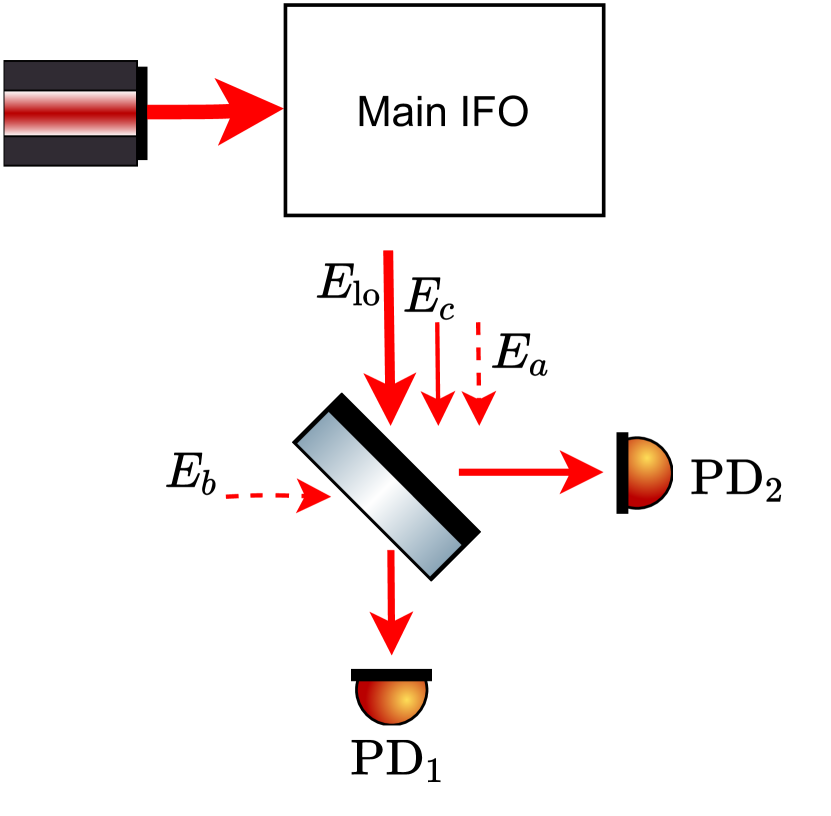
Yu, Martynov, Adhikari & Chen (2022) proposed using quantum correlation techniques to expose signals buried below the shot noise limit. The method exploits the fact that a single interferometer’s antisymmetric port contains two independent optical channels; cross-correlating their outputs cancels the shot noise (which is independent in each channel) while preserving any common physical signal. This is conceptually similar to cross-correlating two separate detectors, but requires only a single instrument — increasing the duty cycle and eliminating systematic differences between detectors.
Quantum correlation sensitivity
In the quantum correlation scheme, the two outputs of the readout beam splitter carry the same gravitational-wave (or quantum-gravity) signal but independent vacuum fluctuations. The cross-spectral density between the two outputs is:
\[C_{12}(f) = |T(f)|^2 S_\text{signal}(f)\]where $T(f)$ is the interferometer transfer function and $S_\text{signal}$ is the power spectral density of the physical signal. The shot noise contribution to $C_{12}$ averages to zero with integration time $T_\text{obs}$. The minimum detectable signal scales as:
\[S_\text{signal}^\text{min} \propto \frac{S_\text{shot}}{|T(f)|^2 \sqrt{T_\text{obs} \cdot \Delta f}}\]where $\Delta f$ is the frequency resolution bandwidth. The $1/\sqrt{T_\text{obs}}$ scaling means that arbitrarily weak signals can in principle be detected with sufficient integration time — a powerful tool for stochastic quantum-gravity searches where the signal is continuous.
This technique is directly applicable to tabletop quantum gravity searches: any experiment limited by shot noise at the frequencies of interest can benefit from quantum correlation readout. The connection to our PSOMA project is immediate — phase-sensitive amplification provides another route to sub-SQL sensitivity, and the two techniques can be combined.
Why these approaches? Competing strategies
The tabletop quantum gravity landscape includes several experimental strategies beyond those we pursue. Here is how they compare:
High-energy colliders
The most direct test of quantum gravity would be to produce gravitons at a particle accelerator. But the gravitational cross-section is suppressed by $(E/E_P)^2$, where $E_P \sim 10^{19}$ GeV is the Planck energy. At the LHC ($E \sim 10^4$ GeV), this suppression factor is $\sim 10^{-30}$ — rendering graviton production undetectable. Models with large extra dimensions (ADD, Randall-Sundrum) could enhance the cross-section, but LHC null results have pushed these models to the margins.
Atom interferometry
Matter-wave interferometry with atoms in free fall offers exquisite sensitivity to gravitational fields and inertial effects. The MAGIS (Mid-band Atomic Gravitational wave Interferometric Sensor) and AION proposals aim to use long-baseline atom interferometers for gravitational-wave detection and tests of the equivalence principle. Atom interferometers are particularly well suited to low-frequency gravitational measurements (0.01–10 Hz), complementing LIGO’s audio band. However, the individual atom mass ($\sim 10^{-25}$ kg) limits their sensitivity to mass-dependent decoherence effects compared to optomechanical systems with $\mu$g–mg test masses.
Neutron interferometry and bouncing neutrons
Neutron experiments provide unique access to gravity at the nuclear scale. The qBounce experiment (Jenke et al.) measures quantum states of neutrons bouncing in Earth’s gravitational field, constraining short-range modifications to Newtonian gravity. The precision is impressive ($\sim 10^{-15}$ eV energy resolution) but the mass is fixed at one neutron mass, limiting the reach for models where effects scale with mass.
Torsion balances
Torsion balances (Eot-Wash group, Kapner et al. 2007) provide the best laboratory constraints on deviations from Newtonian gravity at sub-millimeter distances. These experiments test the inverse-square law down to $\sim 50$ $\mu$m, constraining extra dimensions and Yukawa-type fifth forces. They are highly complementary to interferometric approaches: torsion balances probe static or slowly varying gravitational effects, while interferometers probe dynamic (oscillatory) effects at higher frequencies.
Our contributions
-
Laboratory search framework for spacetime dissipation (Yang, Price, Smith, Adhikari, Miao & Chen 2015) — Developed the phenomenological framework for searching for gravitational dissipation with tabletop optomechanical experiments. Analyzed four detector geometries, computed full noise budgets including quantum vacuum, thermal, and seismic noise, and identified the pendulum configuration as optimal for broadband sensitivity below 1 Hz.
-
Phase-sensitive optomechanical amplification (Bai, Venugopalan, Kuns, Wipf, Markowitz, Wade, Chen & Adhikari 2020) — Proposed PSOMA, a phase-sensitive optomechanical amplifier that evades the standard quantum limit by amplifying only one quadrature of the mechanical motion. This enables sub-SQL displacement measurements essential for detecting the tiny signals predicted by quantum gravity models. See also the PSOMA project page.
-
Quantum correlation readout (Yu, Martynov, Adhikari & Chen 2022) — Developed the quantum correlation technique for exposing signals below the shot noise limit using cross-correlation of two readout channels within a single interferometer. This technique is directly applicable to stochastic quantum-gravity searches, increasing the effective integration time without requiring a second detector.
-
Dark matter detection with laser interferometers (Hall, Adhikari, Frolov, Müller & Pospelov 2018) — Analyzed the sensitivity of LIGO and LISA to macroscopic dark matter objects, showing that gravitational-wave detectors can probe the unexplored mass range from milligrams to metric tons. Derived event rates, signal templates, and discrimination strategies for dark matter transients.
Current status and future directions
Current status: The theoretical and design foundations are established through the four published papers above. The experimental program draws on techniques being developed across several EGG projects: quantum state preparation for non-classical mechanical states, PSOMA for sub-SQL readout, precision optomechanical platforms for ultra-low-noise mechanical systems, and computational experiment design for optimizing detector configurations.
Near-term goals:
- Apply the spacetime dissipation search framework to existing LIGO data, placing constraints on $\gamma_\text{grav}$ from the O4 observing run.
- Design a dedicated tabletop interferometer optimized for the 0.01–10 Hz band, where the spacetime dissipation signal is strongest and pendulum-based detectors are most sensitive.
Open physics questions:
- Model discrimination: Different quantum gravity theories predict qualitatively different signatures. Can a single experiment distinguish between holographic noise, CSL collapse, and spacetime dissipation, or are dedicated instruments needed for each?
- The decoherence frontier: What is the largest mass for which quantum superposition has been demonstrated? The current record is $\sim 25,000$ amu (Fein et al. 2019). Closing the gap to the gravitational decoherence regime ($\sim 10^9$ amu) requires advances in source preparation, environmental isolation, and readout sensitivity.
- Signal versus background: Even if excess noise is observed in a precision interferometer, distinguishing a quantum-gravity signal from mundane sources (scattered light, electronics noise, thermal fluctuations) requires careful null tests and cross-correlation between independent instruments.
- Connecting to astrophysics: Can laboratory constraints on quantum gravity models be related to cosmological signatures? For example, bounds on CSL parameters from LIGO also constrain the primordial power spectrum; bounds on spacetime dissipation constrain the equation of state of the quantum gravity vacuum.
Key references
Spacetime dissipation
- Yang, Price, Smith, Adhikari, Miao & Chen, “Towards the Laboratory Search for Space-Time Dissipation,” arXiv:1504.02545 (2015). arXiv — Phenomenological framework for spacetime dissipation searches with four detector geometries.
Holographic noise
- Verlinde & Zurek, “Observational signatures of quantum gravity in interferometers,” Phys. Lett. B 822, 136663 (2021). DOI:10.1016/j.physletb.2021.136663 — Theoretical prediction of geontropic holographic noise in interferometers.
- Zurek, “On vacuum fluctuations in quantum gravity and interferometer arm fluctuations,” Phys. Lett. B 826, 136910 (2022). DOI:10.1016/j.physletb.2022.136910 — Further development of the holographic noise framework.
- Chou et al., “The Holometer: An instrument to probe Planckian quantum geometry,” CQG 34, 065005 (2017). DOI:10.1088/1361-6382/aa5e5c — The Fermilab Holometer: design and null result.
- Vermeulen et al., “GQuEST: Gravitational Quantum Entanglement of Spacetime,” arXiv:2404.07524 (2024). arXiv — Next-generation photon-counting interferometer for holographic noise.
- McCuller et al., “Single-photon signal sideband detection for high-power Michelson interferometers,” arXiv:2406.07381 (2024). arXiv — Photon-counting readout techniques for holographic noise searches.
Gravitational decoherence and collapse models
- Penrose, “On gravity’s role in quantum state reduction,” Gen. Relativ. Gravit. 28, 581 (1996). DOI:10.1007/BF02105068 — The Penrose proposal for gravitational collapse of quantum superpositions.
- Diosi, “Models for universal reduction of macroscopic quantum fluctuations,” Phys. Rev. A 40, 1165 (1989). DOI:10.1103/PhysRevA.40.1165 — The Diosi gravitational decoherence model.
- Bassi, Lochan, Satin, Singh & Ulbricht, “Models of wave-function collapse,” Rev. Mod. Phys. 85, 471 (2013). DOI:10.1103/RevModPhys.85.471 — Comprehensive review of collapse models including CSL.
Gravity-mediated entanglement (BMV)
- Bose et al., “Spin Entanglement Witness for Quantum Gravity,” PRL 119, 240401 (2017). DOI:10.1103/PhysRevLett.119.240401 — The BMV proposal for testing quantum gravity via entanglement.
- Marletto & Vedral, “Gravitationally Induced Entanglement between Two Massive Particles is Sufficient Evidence of Quantum Effects of Gravity,” PRL 119, 240402 (2017). DOI:10.1103/PhysRevLett.119.240402 — The information-theoretic argument.
Dark matter with interferometers
- Hall, Adhikari, Frolov, Müller & Pospelov, “Laser Interferometers as Dark Matter Detectors,” Phys. Rev. D 98, 083019 (2018). DOI:10.1103/PhysRevD.98.083019 — Sensitivity analysis for LIGO and LISA to macroscopic dark matter.
Quantum-enhanced readout
- Yu, Martynov, Adhikari & Chen, “Exposing gravitational waves below the quantum sensing limit,” Phys. Rev. D 106, 063017 (2022). DOI:10.1103/PhysRevD.106.063017 — Quantum correlation technique for sub-shot-noise signal detection.
- Bai, Venugopalan, Kuns, Wipf, Markowitz, Wade, Chen & Adhikari, “Phase-sensitive optomechanical amplifier for quantum noise reduction in laser interferometers,” Phys. Rev. A 102, 023507 (2020). DOI:10.1103/PhysRevA.102.023507 — PSOMA concept for sub-SQL displacement measurement.
Experimental frontiers
- Fein et al., “Quantum superposition of molecules beyond 25 kDa,” Nature Physics 15, 1242 (2019). DOI:10.1038/s41567-019-0663-9 — Current mass record for matter-wave interference.
- Kapner et al., “Tests of the Gravitational Inverse-Square Law below the Dark-Energy Length Scale,” PRL 98, 021101 (2007). DOI:10.1103/PhysRevLett.98.021101 — Eot-Wash torsion balance constraints on sub-millimeter gravity.
- Vinante et al., “Improved Noninterferometric Test of Collapse Models Using Ultracold Cantilevers,” PRL 125, 100404 (2020). DOI:10.1103/PhysRevLett.125.100404 — Strongest laboratory constraint on CSL from cryogenic cantilevers.
Further reading
For readers who want to go deeper:
- Carney, Stamp & Taylor, “Tabletop experiments for quantum gravity: a user’s manual,” CQG 36, 034001 (2019). DOI:10.1088/1361-6382/aaf9ca — Comprehensive review of tabletop quantum gravity proposals, experimental requirements, and noise budgets.
- Anastopoulos & Hu, “Probing a gravitational cat state,” CQG 32, 165022 (2015). DOI:10.1088/0264-9381/32/16/165022 — Theoretical framework for testing gravitational decoherence with macroscopic superpositions.
- Aspelmeyer, Kippenberg & Marquardt, “Cavity optomechanics,” Rev. Mod. Phys. 86, 1391 (2014). DOI:10.1103/RevModPhys.86.1391 — The standard reference for cavity optomechanics, the enabling technology for most tabletop quantum gravity proposals.
- Addazi et al., “Quantum gravity phenomenology at the dawn of the multi-messenger era,” Prog. Part. Nucl. Phys. 125, 103948 (2022). DOI:10.1016/j.ppnp.2022.103948 — Broad review of quantum gravity phenomenology across all experimental frontiers.