Sum Frequency Generation for high QE wavelength conversion
Cavity-enhanced sum-frequency generation to upconvert 2 µm photons to visible wavelengths, enabling silicon photodetectors with near-unity quantum efficiency for future gravitational-wave detectors.
Gallery
Research area
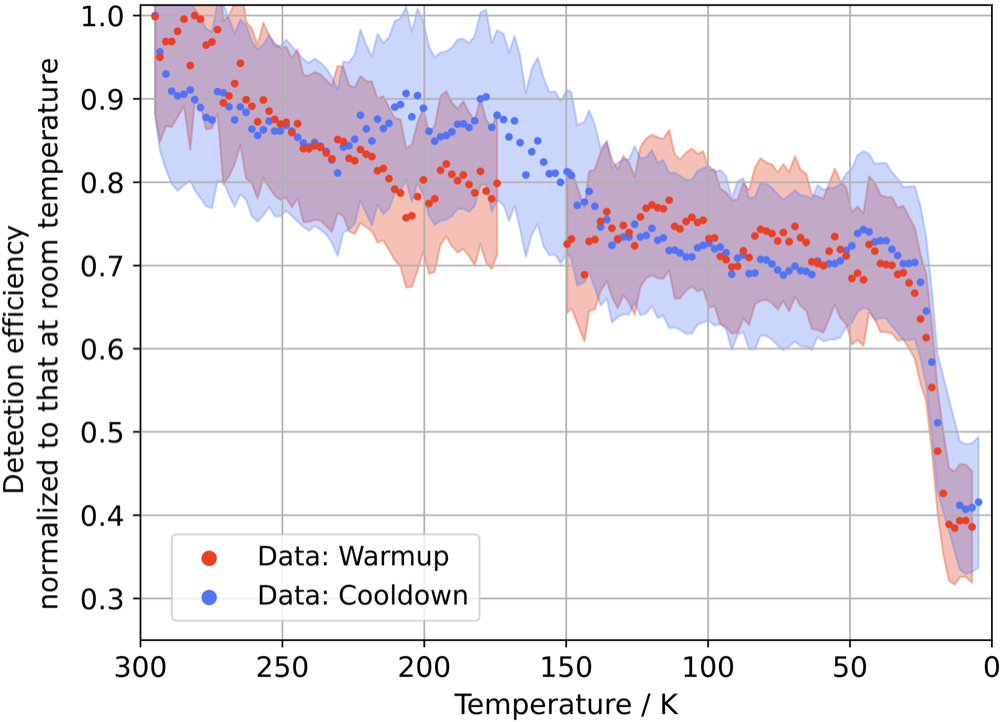
Future gravitational-wave detectors — LIGO Voyager and beyond — will operate at ~2 µm wavelength to exploit the exceptional mechanical and optical properties of crystalline silicon test masses cooled to 123 K. But the best available photodetectors at 2 µm are extended InGaAs diodes, which suffer from high dark noise at low frequencies and quantum efficiency (QE) that degrades with cooling (Gurs et al. 2025). Silicon photodetectors achieve near-unity QE — but their bandgap cuts off at ~1100 nm.
The solution: convert 2 µm photons to visible wavelengths where silicon detectors excel. Sum-frequency generation (SFG) does exactly this — translating each signal photon to ~700 nm while preserving its quantum state.
Contents:
- The SFG scheme
- The physics of three-wave mixing
- Scaling relations
- Why cavity enhancement?
- Noise mechanisms
- Why SFG? Competing approaches
- Technical challenges
- The LIGO Voyager context
- Connections to other fields
- Our contributions
- Current status and future directions
- Key references
- Further reading
The SFG scheme
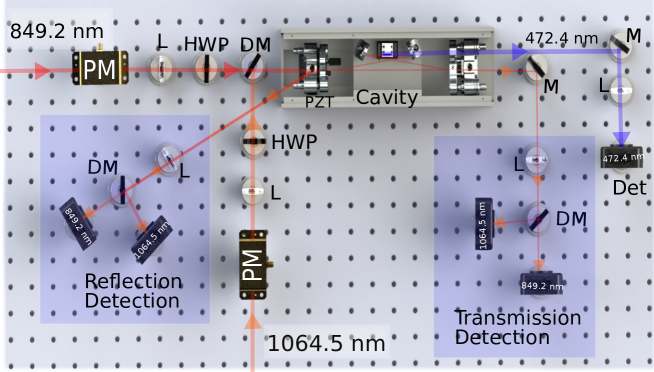
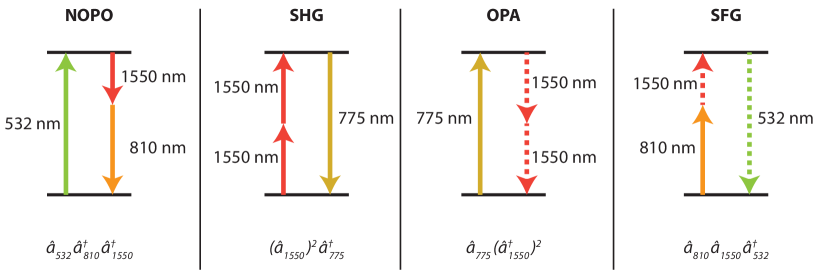
In sum-frequency generation, a signal photon at 2050 nm (from the interferometer output) combines with a pump photon at 1064 nm (from a Nd:YAG laser) inside a nonlinear crystal to produce a single photon at ~700 nm — deep red, well within silicon’s peak sensitivity. Energy conservation dictates $\omega_3 = \omega_1 + \omega_2$: every signal photon consumed produces exactly one converted photon, preserving the quantum state of the light.
The nonlinear medium is periodically poled lithium niobate (PPLN), a 20 mm long crystal with engineered domain inversions that provide quasi-phase-matching across the full crystal length. PPLN’s large nonlinear coefficient ($d_{33} \approx 25$ pm/V) makes it the material of choice for efficient three-wave mixing at these wavelengths.
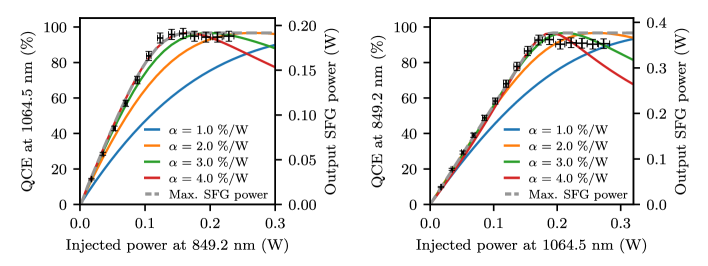
The idea of using nonlinear frequency conversion for quantum-limited detection has a 35-year lineage: Kumar (1990) proved theoretically that quantum frequency conversion preserves arbitrary quantum states. Huang & Kumar (1992) demonstrated this experimentally. The Fejer group at Stanford developed PPLN into a practical technology. Albota & Wong (2004) demonstrated 90% cavity-enhanced SFG. Xia et al. (2014) at NASA showed 94% intrinsic upconversion at exactly 2.05 µm — the same wavelength as LIGO Voyager. Kerdoncuff et al. (2020) pushed the record to 95% internal quantum conversion efficiency. Our prototype (2025) is bringing this technology to gravitational-wave readout.
The physics of three-wave mixing
Why nonlinearity?
In everyday materials, light waves pass through each other without interacting — photons are oblivious to one another. A nonlinear crystal changes this. Its polarization response to an applied electric field is:
\[\mathbf{P} = \varepsilon_0\!\left(\chi^{(1)}\mathbf{E} + \chi^{(2)}\mathbf{E}^2 + \cdots\right)\]The $\chi^{(1)}$ term is ordinary refraction. The $\chi^{(2)}$ term is the translator: it takes two input fields oscillating at different frequencies and generates new fields at the sum and difference frequencies. This second-order nonlinearity exists only in materials that lack inversion symmetry — ruling out glasses, gases, and most common materials, but permitting crystals like lithium niobate (LiNbO$_3$) where the atomic lattice has a preferred direction.
PPLN’s effective coefficient $d_{33} \approx 25$ pm/V is among the highest of any optical material, making it the workhorse for three-wave mixing.
Phase matching: why crystals have a maximum useful length
SFG light generated at position z in the crystal propagates forward and interferes with SFG generated at z + dz. If the three waves travel at different phase velocities (they do — this is dispersion), the interference becomes destructive after one coherence length:
\[L_c = \frac{\pi}{\Delta k}, \qquad \Delta k = k_3 - k_1 - k_2\]For bulk LiNbO$_3$ at our wavelengths, $L_c \approx 10\;\mu$m. A crystal longer than ~10 µm is actually worse than a shorter one — the SFG field grows, then cancels itself, then grows again. This seems catastrophic for building a practical device.
Quasi-phase matching: PPLN’s elegant trick
The fix: flip the sign of the nonlinear coefficient every coherence length. This resets the phase mismatch before destructive interference can take hold, allowing the SFG field to grow monotonically across the entire crystal.
In PPLN, this is achieved by periodically inverting the ferroelectric domain orientation — creating alternating regions where $d_{33}$ flips sign. With a poling period $\Lambda = 2L_c$, the effective interaction length goes from ~10 µm to the full 20 mm — a factor of ~2000×. The price: $d_\text{eff}$ is reduced by a factor of $2/\pi$ (from $d_{33} \approx 25$ pm/V to $d_\text{eff} \approx 14$ pm/V for first-order QPM). A small price for a 2000× longer interaction.
Temperature tunes the phase-matching condition through thermal expansion and the thermo-optic effect, making temperature the primary control knob.
The coupled-wave equations
How three fields exchange energy
The three fields evolve as they propagate through the crystal:
\[\frac{dA_1}{dz} = -i\kappa_1\, A_3\, A_2^*\, e^{-i\Delta k\, z} \qquad \text{[signal, 2050 nm]}\] \[\frac{dA_2}{dz} = -i\kappa_2\, A_3\, A_1^*\, e^{-i\Delta k\, z} \qquad \text{[pump, 1064 nm]}\] \[\frac{dA_3}{dz} = -i\kappa_3\, A_1\, A_2\, e^{+i\Delta k\, z} \qquad \text{[SFG output, \sim700 nm]}\]where $\kappa_i = \omega_i\, d_\text{eff}/(n_i c)$. Energy flows from signal + pump into SFG output. In the undepleted-pump approximation (pump much stronger than signal), the signal decays and the SFG field grows along the crystal length.
The key quantum insight (Kumar 1990): At 100% conversion efficiency, the quantum state of the signal field is transferred to the output frequency — not destroyed, not copied, not amplified. Entanglement, squeezing, photon number statistics: all preserved. This is translation, not amplification. An amplifier adds noise; a perfect frequency converter does not.
Scaling relations
Single-pass conversion efficiency
In the undepleted-pump approximation with perfect phase matching ($\Delta k = 0$):
\[\eta_\text{SP} = \frac{8\pi^2\, d_\text{eff}^2\, L^2\, P_\text{pump}}{n_1\, n_2\, n_3\, \varepsilon_0\, c\, \lambda_3^2\, A_\text{eff}}\]Worked numerical example
For our system: $d_\text{eff} = 14$ pm/V, $L = 20$ mm, $P_\text{pump} = 10$ W, beam waist $w = 50\;\mu$m ($A_\text{eff} = \pi w^2$):
- Numerator: $8\pi^2 \times (14\times10^{-12})^2 \times (0.02)^2 \times 10 \approx 6.1\times10^{-22}$
- Denominator: $2.15 \times 2.15 \times 2.20 \times 8.85\times10^{-12} \times 3\times10^{8} \times (700\times10^{-9})^2 \times \pi\times(50\times10^{-6})^2$
- $\eta_\text{SP} \approx 3\%$
Three percent from a single pass — this is why we need cavity enhancement.
The phase-matching $\operatorname{sinc}^2$ function
With imperfect phase matching, efficiency falls as:
\[\eta(\Delta k) = \eta_0 \times \operatorname{sinc}^2\!\left(\frac{\Delta k\, L}{2}\right)\]For our 20 mm PPLN crystal:
- Temperature bandwidth: $\Delta T \approx 2.5$ °C (from the empirical rule $\Delta T \times L \approx 5$ °C·cm)
- Wavelength bandwidth: $\Delta\lambda \approx 0.5$ nm at 2050 nm
The $\operatorname{sinc}^2$ function is why temperature stability matters — a few-degree drift can cut efficiency to zero.
Boyd-Kleinman focusing optimization
Optimal focusing in nonlinear crystals
The plane-wave formula assumes a uniform beam — unrealistic for focused Gaussian beams. Boyd & Kleinman (1968) showed the efficiency scales as:
\[\eta_\text{focused} \propto \frac{L}{b}\, h(B, \xi)\]where $\xi = L/b$ ($b$ = confocal parameter $= 2\pi w_0^2 n/\lambda$) and $B$ is the birefringence walk-off parameter. For quasi-phase-matched materials like PPLN ($B = 0$, no walk-off), the optimal focusing is $\xi_\text{opt} \approx 2.84$, giving $h_\text{max} \approx 1.068$.
Key insight: Because PPLN uses quasi-phase-matching (no walk-off), the focused-beam result is nearly identical to the plane-wave limit. This is a major practical advantage over critically phase-matched crystals like BBO or KTP, where walk-off severely limits the usable crystal length.
Cavity enhancement and impedance matching
Placing the crystal in a resonant cavity multiplies the effective pump power by the buildup factor:
\[P_\text{circ} = P_\text{in} \times \frac{T_1}{\left(1 - \sqrt{(1-T_1)(1-L_\text{RT})}\right)^2}\]For input coupler transmission $T_1 = 3\%$ and round-trip loss $L_\text{RT} = 0.3\%$, the buildup is ~30×. This transforms 10 W of input into ~300 W circulating, pushing $\eta$ from 3% toward 90%+.
A subtlety: maximum buildup occurs when the input coupler transmission matches the total round-trip loss — this is impedance matching. But the nonlinear conversion itself acts as additional loss. As signal power increases and more pump is converted, the effective loss increases, de-tuning the impedance match. The cavity must be designed for the operating point, not just the cold-cavity parameters.
The depleted-pump regime
Back-conversion and Jacobi elliptic functions
At high conversion, the undepleted-pump approximation breaks down. For SFG with $\Delta k = 0$ and weak signal, the exact solution is:
\[\eta = \sin^2(\kappa_\text{eff} \times L)\]This predicts oscillation between full conversion and full back-conversion:
- At $\kappa_\text{eff} L = \pi/2$: 100% conversion (first maximum)
- At $\kappa_\text{eff} L = \pi$: 0% conversion (SFG photons re-split into signal + pump)
- The system periodically cycles between these extremes
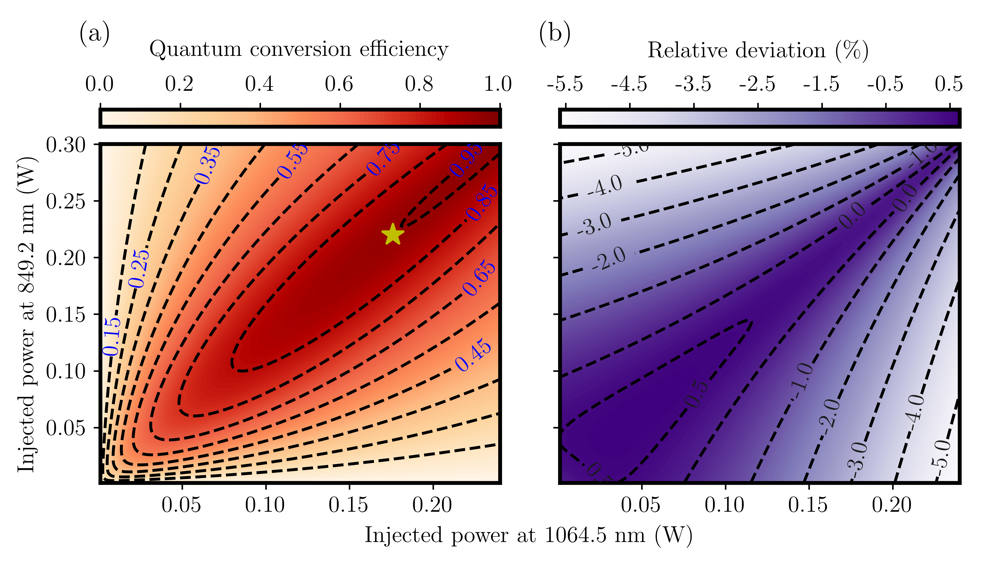
For the general case (arbitrary input power ratio), the solution involves Jacobi elliptic functions. The practical lesson: the cavity must operate at or below the first conversion maximum. Overshooting leads to less output, not more.
Bandwidth and gravitational-wave signals
Why cavity enhancement?
Single-pass SFG efficiency is low at modest pump powers — a few percent at best (see scaling relations above). Placing the PPLN crystal inside a resonant cavity multiplies the effective pump power by the cavity finesse, dramatically increasing conversion efficiency without requiring a more powerful laser.
Our design uses a 4-mirror bow-tie ring cavity, resonant at the 1064 nm pump wavelength and locked via Pound-Drever-Hall (PDH) feedback. The bow-tie geometry avoids back-reflections into the pump laser and provides two separate foci: one tight waist inside the PPLN crystal for efficient nonlinear interaction, and a second waist available for diagnostics.
Critically, the signal beam (2050 nm) passes through the cavity in a single pass — it is not resonated. This means the signal’s quantum state passes through the system only once, minimizing decoherence and losses. The cavity enhances only the pump field, which is classical.
Noise mechanisms
The entire motivation for SFG is quantum-noise-limited readout. If the conversion process adds noise, it defeats the purpose. Here we catalog the noise sources and explain why each can be controlled.
Spontaneous parametric down-conversion (SPDC)
The same $\chi^{(2)}$ nonlinearity that enables SFG also allows the reverse: pump photons spontaneously splitting into photon pairs, one of which may land at the SFG output wavelength. These noise photons are indistinguishable from converted signal photons.
However, our wavelength configuration provides natural suppression. SPDC noise at 700 nm would require 1064 nm pump photons to split into a 700 nm photon plus a ~2 µm photon — but this is exactly the reverse of the SFG process and is suppressed by the same phase-matching condition that enhances conversion. As Pelc et al. (2011) showed, long-wavelength pumping geometrically suppresses SPDC noise at the output wavelength.
Spontaneous Raman scattering
The dominant noise source (Kuo et al. 2013, 2018). Pump photons scatter inelastically off optical phonons in the PPLN crystal, producing broadband fluorescence that can overlap the SFG output wavelength. Unlike SPDC, Raman scattering is not phase-matched and cannot be eliminated by crystal design.
Mitigation strategies:
- Crystal cooling: Reducing the PPLN temperature lowers the phonon population. Kuo et al. (2018) demonstrated a 3× noise reduction by cooling from 85 °C to 40 °C.
- Spectral filtering: The Raman spectrum is broad; the SFG signal is narrow. A bandpass filter at ~700 nm rejects most Raman photons.
- Crystal length trade-off: Shorter crystals produce less Raman noise but also less SFG signal. The optimal length balances conversion efficiency against noise.
Pump noise transfer
Amplitude noise on the 1064 nm pump modulates the SFG output: in the linear regime, $\delta P_3/P_3 \approx \delta P_2/P_2$ — intensity noise transfers 1:1. At audio frequencies (1–100 Hz), laser intensity noise typically rises as 1/f, making this the critical noise source for GW readout.
Our earlier work established that nonlinear conversion itself is remarkably quiet: Yeaton-Massey & Adhikari (2012) bounded excess frequency noise in second harmonic generation at the $10^{-19}$ level — demonstrating that the nonlinear process does not inherently introduce significant technical noise.
Thermal noise in the PPLN crystal
At audio frequencies, thermorefractive noise — driven by temperature fluctuations in the illuminated crystal volume — can modulate the phase-matching condition and cavity resonance. This is analogous to coating thermal noise in LIGO mirrors. Quantifying this noise at 1–100 Hz is one of our near-term experimental goals.
Why SFG? Competing approaches
SFG is not the only option for high-QE detection at 2 µm. Here’s why it’s the best one.
Improve InGaAs directly
The most obvious approach: make better 2 µm photodetectors. But Gurs et al. (2025) showed that InGaAs QE degrades with cooling — the opposite of what’s needed for cryogenic detectors. Room-temperature InGaAs peaks at ~80% QE, well below the >99% required for quantum-noise-limited readout. No clear path exists to close this gap.
Superconducting nanowire single-photon detectors (SNSPDs)
SNSPDs achieve near-unity QE across a broad wavelength range, including 2 µm — the gold standard for photon counting. But GW readout is not photon counting. It’s continuous homodyne detection with ~100 mW of optical power on the photodetector. SNSPDs have nanosecond dead times and cannot operate in this high-power continuous regime.
Heterodyne readout
Heterodyne detection mixes the signal with a local oscillator at a different frequency. No wavelength conversion needed. But heterodyne fundamentally measures both signal quadratures simultaneously, incurring a 3 dB quantum noise penalty — equivalent to losing half the detected events. For a quantum-noise-limited observatory, this is a steep price.
Optical parametric amplification (OPA)
Amplify the 2 µm signal before detection to overcome detector noise. Phase-sensitive OPA avoids the 3 dB penalty of phase-insensitive amplifiers. But any noiseless amplifier is mathematically equivalent to — and as difficult to build as — perfect frequency conversion. OPA and SFG are governed by the same coupled-wave equations; SFG is the more natural choice when the goal is wavelength bridging.
Alternative detector materials (HgCdTe, InAsSb)
Mercury cadmium telluride (MCT) detectors have tunable bandgaps and are the workhorse of infrared astronomy. But two fundamental problems make them unsuitable for GW homodyne readout:
Dark noise scales with detector area. GW readout requires collecting ~100 mW of optical power from a homodyne beam, which demands a photodetector active area of order 1 mm diameter. The empirical “Rule 07” model (Tennant et al., J. Electron. Mater. 37, 1406, 2008) shows that HgCdTe dark current density is set by the product of cutoff wavelength and operating temperature — and total dark current scales linearly with area. For a 2.5 µm cutoff device at moderate cryogenic temperatures, a 1 mm diameter detector has a shunt resistance of only ~11 M$\Omega$ at $-70$ °C — roughly 500× worse than a standard 1.7 µm InGaAs device of the same size (Yoon et al., Proc. SPIE 6297, 629703, 2006). This directly translates to Johnson noise and 1/f noise that dominate in the 1–100 Hz band critical for GW detection.
Power handling is undemonstrated. HgCdTe detectors are designed for low-flux applications — astronomical imaging, spectroscopy, thermal sensing. Homodyne readout concentrates ~100 mW onto the active area, creating irradiance levels far beyond normal operating conditions. Theocharous et al. (Appl. Opt. 43, 4182, 2004) showed that HgCdTe nonlinearity is a function of irradiance (power per unit area), meaning that the high optical power required for GW readout drives the detector into nonlinear response. No HgCdTe detector has been demonstrated to operate linearly at the milliwatt power levels required, let alone at 100 mW.
The LIGO Voyager design paper (Adhikari et al. 2020) evaluated all three candidate technologies — extended InGaAs, HgCdTe, and InAsSb — and found that none currently meets the simultaneous requirements of >99% QE, linearity at high power, and low noise at audio frequencies.
Technical challenges
-
Thermal lensing in PPLN: Even modest absorption creates refractive-index gradients that act as parasitic lenses, distorting the cavity eigenmode. PPLN has $dn/dT \approx 37\times10^{-6}$ K$^{-1}$ — roughly 4× larger than fused silica — making thermal management critical as circulating power increases.
-
Phase matching: Quasi-phase-matching must be maintained across the full crystal length as temperature and circulating power change. Temperature tuning provides coarse control, but power-dependent thermal gradients can degrade the phase-matching condition.
-
Mode overlap: The signal (2050 nm) and pump (1064 nm) beams have very different diffraction properties. Both must overlap spatially throughout the 20 mm crystal for efficient conversion, requiring careful cavity mode design.
-
Pump noise transfer: Amplitude and frequency noise on the 1064 nm pump can contaminate the converted signal. Our earlier work on excess frequency noise in SHG and multicolor cavity metrology directly informs the noise budget for this system.
The LIGO Voyager context
Why does any of this matter? The answer is in the next generation of gravitational-wave observatories.
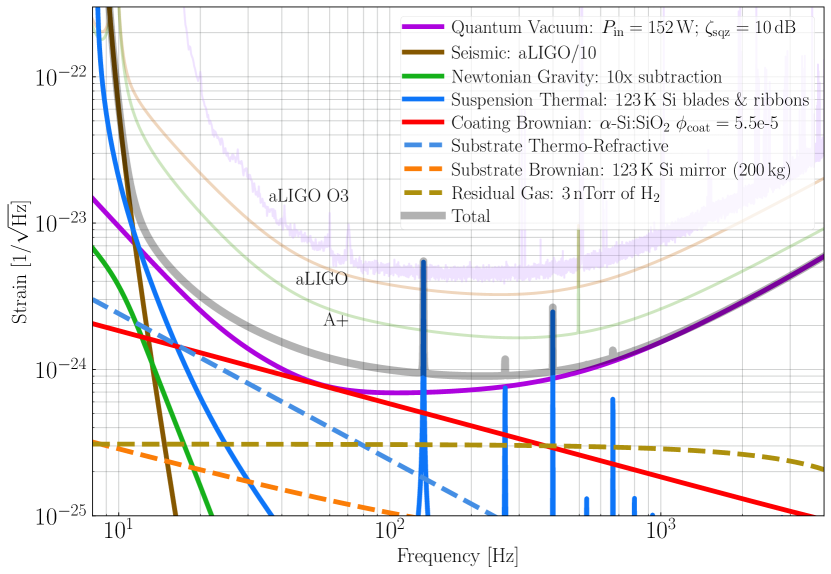
LIGO Voyager replaces the current fused silica optics with silicon test masses cooled to 123 K — the temperature where silicon’s thermal expansion coefficient crosses zero, eliminating thermo-elastic noise. Silicon at 123 K has roughly 10× lower thermal noise than room-temperature fused silica. But silicon is opaque at the current LIGO wavelength (1064 nm). The laser must shift to 2 µm, where silicon is transparent.
The readout chain becomes: interferometer (2 µm) → SFG cavity → silicon photodetector (700 nm). The SFG stage must be lossless, noiseless, and broadband — essentially invisible to the gravitational-wave signal.
Beyond Voyager, future longer-baseline detectors will also operate at 2 µm, also requiring high-QE wavelength conversion. The precision optical coatings project in our group addresses the multi-band coating challenge for SFG cavity mirrors, which must operate simultaneously at 1064 nm, 2050 nm, and 700 nm.
Connections to other fields
The cavity-enhanced SFG techniques developed here — managing thermal effects in PPLN, maintaining phase matching under high circulating power, and preserving quantum signal fidelity — apply directly across multiple domains.
Quantum Networking
Long-distance quantum networks transmit photons at telecom wavelengths (1550 nm) but store them in atomic memories at visible wavelengths (Rb at 780 nm, Er at 1530 nm). SFG is the bridge between fiber-optic transmission and atomic storage. It must preserve entanglement and single-photon statistics — exactly the same fidelity requirement as GW readout. (Albota & Wong 2004; Pelc thesis 2012)
Mid-Infrared Spectroscopy
Molecular vibrational fingerprints lie in the 2–10 µm range, but the best cameras and single-photon counters are silicon-based. Upconversion detection translates mid-IR molecular signatures to visible wavelengths where silicon sensors excel. Xia et al. (2014) demonstrated 94% upconversion at exactly 2.05 µm with a 1064 nm pump in PPLN — the exact same wavelength scheme as our GW readout system.
Single-Photon Counting at Telecom Wavelengths
SFG combined with silicon avalanche photodiodes achieves higher detection efficiency (~90%), lower timing jitter (<100 ps), and lower dark counts than native InGaAs single-photon detectors. This has become the dominant approach for single-photon detection in quantum key distribution at 1550 nm. (Langrock et al. 2004, 2005)
Astronomical Interferometry
Stellar interferometry at thermal-IR wavelengths (3–10 µm) is limited by detector noise. Upconversion to silicon wavelengths could extend the reach of long-baseline optical/IR interferometers like the VLTI and future space missions, bringing silicon-detector performance to thermal-IR astronomy.
Squeezed Light at 2 µm
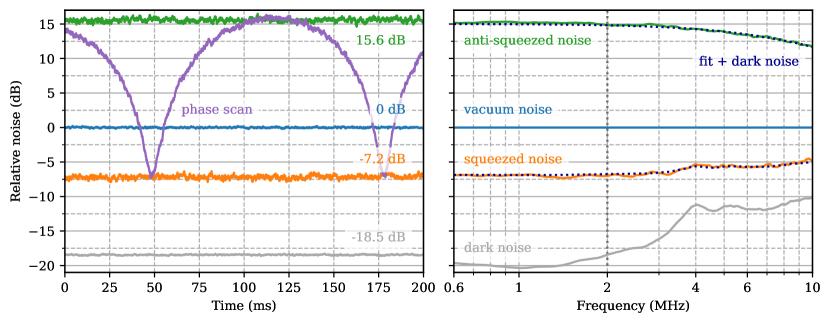
Quantum noise reduction via squeezed light is already deployed in LIGO at 1064 nm. For Voyager at 2 µm, squeezing must be generated and detected at the new wavelength. Mansell et al. (2018) demonstrated 4.0 dB squeezing at 2 µm; Darsow-Fromm et al. (2021) achieved 7.2 dB at 2128 nm. But exploiting squeezing requires high-QE readout — exactly what SFG provides. Vollmer et al. (2014) proved that squeezed vacuum states survive the SFG process intact.
Our contributions
-
Excess noise bound in SHG (Yeaton-Massey & Adhikari 2012) — Established a new bound on excess frequency noise in second harmonic generation with PPKTP at the $10^{-19}$ level, demonstrating that nonlinear frequency conversion need not introduce significant technical noise. This result underpins the entire SFG viability argument.
-
Multicolor cavity metrology (Izumi, Arai, …, Adhikari et al. 2012) — Developed techniques for simultaneous resonance of multiple wavelengths in a single cavity, directly applicable to the pump-resonant SFG cavity design where 1064 nm, 2050 nm, and 700 nm must all be managed.
-
High-power low-noise photodetection (Grote, Weinert, Adhikari et al. 2016) — Characterized photodetector performance for squeezed-light-enhanced detectors, establishing the noise floor requirements that SFG-converted light must meet.
-
Cryogenic silicon interferometer design (Adhikari, Arai, Brooks, Wipf et al. 2020) — The LIGO Voyager conceptual design that establishes the 2 µm operating wavelength and motivates the need for high-QE wavelength conversion.
Current status and future directions
Current status: An engineering prototype is being commissioned in the EGG lab, demonstrating the SFG effect and commissioning the control electronics. A next-generation system is in design, targeting full high-QE conversion.
Near-term goals (next-gen system):
- Full high-QE cavity-enhanced SFG at 2050 nm + 1064 nm → 700 nm
- Pump noise transfer characterization at audio frequencies (1–100 Hz) — the critical band for GW detection
- Thermal lensing management under sustained high circulating power
- End-to-end QE validation: mode-matching × cavity coupling × conversion efficiency × photodetector QE > 99%
Open physics questions:
- Conversion efficiency at scale: Lab demonstrations achieve 95% internal QCE, but the full LIGO readout chain demands >99% end-to-end. What is the realistic efficiency ceiling including mode-matching and cavity losses?
- Noise preservation: Does the upconversion process preserve the quantum state faithfully enough for squeezed-light-enhanced readout? Pump noise, spontaneous Raman scattering, and thermal noise in PPLN could all contaminate the converted signal.
- Broadband operation: The SFG cavity has a finite linewidth. How broad can the conversion bandwidth be while maintaining high efficiency?
- Reliability: A production system would operate continuously for months during observing runs. PPLN crystals can degrade under sustained operation (photorefractive damage, domain wall drift). What is the expected lifetime?
- Squeezed state preservation through the full chain: Vollmer et al. (2014) showed squeezed vacuum survives SFG in a simple setup. But the GW readout chain adds cavity dynamics, audio-frequency quantum correlations, and high circulating power. Does it still work?
- Waveguide vs bulk crystal: Thin-film LiNbO$_3$ (TFLN) waveguides achieve normalized efficiencies 100–1000× higher per unit pump power (Wang et al. 2018: 2600%/W·cm$^2$). Could chip-scale SFG replace the bulk-crystal cavity? Trade-offs include power handling, thermal dynamics, and fiber coupling loss.
- Cascaded conversion: Space-based detectors may operate at even longer wavelengths. Multi-stage cascaded SFG could extend the approach.
Key references
Foundational theory
- Kumar, “Quantum frequency conversion,” Opt. Lett. 15, 1476 (1990). DOI:10.1364/OL.15.001476 — Proved quantum frequency conversion preserves arbitrary quantum states.
- Huang & Kumar, “Observation of quantum frequency conversion,” PRL 68, 2153 (1992). DOI:10.1103/PhysRevLett.68.2153 — First experimental demonstration.
- Boyd & Kleinman, “Parametric interaction of focused Gaussian light beams,” J. Appl. Phys. 39, 3597 (1968). DOI:10.1063/1.1656831 — Optimal focusing theory for nonlinear crystals.
- Fejer et al., “Quasi-phase-matched second harmonic generation: tuning and tolerances,” IEEE J. Quantum Electron. 28, 2631 (1992). — Definitive QPM theory and PPLN design rules.
- Fejer, “Nonlinear optical frequency conversion,” Physics Today 47, 25 (1994). DOI:10.1063/1.881430 — Accessible review.
Experimental milestones
- Albota & Wong, “Efficient single-photon counting at 1.55 µm by means of frequency upconversion,” Opt. Lett. 29, 1449 (2004). DOI:10.1364/OL.29.001449 — 90% SFG efficiency in cavity-enhanced PPLN.
- Xia et al., “Sensitive infrared signal detection by upconversion technique,” Opt. Eng. 53, 107102 (2014). DOI:10.1117/1.OE.53.10.107102 — 94% upconversion at 2.05 µm + 1064 nm in PPLN — the exact GW readout scheme.
- Kerdoncuff et al., “Cavity-enhanced SFG of blue light with near-unity conversion efficiency,” Opt. Express 28, 3975 (2020). DOI:10.1364/OE.383526 — 95±3% internal QCE (current CW record).
Noise and quantum state preservation
- Pelc et al., “Long-wavelength-pumped upconversion single-photon detector at 1550 nm: performance and noise analysis,” Opt. Express 19, 21445 (2011). DOI:10.1364/OE.19.021445 — Comprehensive noise analysis.
- Kuo et al., “Using temperature to reduce noise in quantum frequency conversion,” Opt. Lett. 43, 2034 (2018). DOI:10.1364/OL.43.002034 — Crystal cooling reduces Raman noise 3×.
- Vollmer et al., “Quantum up-conversion of squeezed vacuum states from 1550 to 532 nm,” PRL 112, 073602 (2014). DOI:10.1103/PhysRevLett.112.073602 — Squeezed vacuum survives SFG.
- Baune et al., “Strongly squeezed states at 532 nm based on frequency up-conversion,” Opt. Express 23, 16035 (2015). DOI:10.1364/OE.23.016035 — 5.5 dB squeezed vacuum via SFG.
2 µm squeezed light
- Mansell et al., “Observation of squeezed light in the 2 µm region,” PRL 120, 203603 (2018). DOI:10.1103/PhysRevLett.120.203603 — First 2 µm squeezing (4.0 dB).
- Darsow-Fromm et al., “Squeezed light at 2128 nm for future gravitational-wave observatories,” Opt. Lett. 46, 5850 (2021). DOI:10.1364/OL.441372 — 7.2 dB squeezing at 2128 nm.
GW detector context
- Adhikari et al., “A cryogenic silicon interferometer for gravitational-wave detection,” CQG 37, 165003 (2020). DOI:10.1088/1361-6382/ab9143 — LIGO Voyager design.
- Gurs et al., “Photodiode quantum efficiency for 2 µm light in gravitational-wave detectors,” arXiv:2511.05961 (2025). arXiv — InGaAs QE degrades with cooling.
Emerging technology: thin-film lithium niobate
- Wang et al., “Ultrahigh-efficiency wavelength conversion in nanophotonic periodically poled lithium niobate waveguides,” Optica 5, 1438 (2018). DOI:10.1364/OPTICA.5.001438 — 2600%/W·cm$^2$ in nanophotonic PPLN.
- Wu et al., “Efficient sum-frequency generation in a thin-film lithium niobate waveguide,” Opt. Lett. 49, 2833 (2024). DOI:10.1364/OL.520655 — 10,097%/W·cm$^2$ SFG in TFLN.
EGG lab
- Amarnath, “Cavity enhanced sum frequency generation for indirect detection of 2 µm photons,” LIGO-T2500235, Caltech SURF Report (2025). LIGO DCC
Further reading
For readers who want to go deeper:
- Boyd, Nonlinear Optics, 4th ed. (Academic Press, 2020) — the standard textbook for $\chi^{(2)}$ processes, coupled-wave equations, and phase matching.
- Pelc, Frequency Conversion of Single Photons: Physics, Devices, and Applications, Stanford PhD thesis (2012). PDF — comprehensive treatment of PPLN waveguide SFG, noise mechanisms, and quantum applications.
- “Single photon frequency up-conversion and its applications,” Physics Reports 521, 69 (2012). DOI:10.1016/j.physrep.2012.07.006 — review covering theory, devices, and applications.
- Langrock et al., “Periodically poled lithium niobate waveguide sum-frequency generator for efficient single-photon detection at communication wavelengths,” Opt. Lett. 29, 1518 (2004). DOI:10.1364/OL.29.001518 — PPLN waveguide SFG achieving >90% efficiency.