
Image: Georgia Mansell / Caltech/MIT/LIGO Lab
Quantum mechanics places hard limits on how precisely we can measure anything. But it also hands us the tools to break those limits. We build the quantum states, optical systems, and feedback controllers that make gravitational-wave detectors and precision instruments see farther than classical physics allows.
Squeezed light is our primary weapon: photons engineered with less noise in one quadrature than the vacuum allows. We helped bring squeezing into Advanced LIGO, and we are now pushing to frequency-dependent squeezing — filter cavities that shape the quantum noise reduction across LIGO's entire detection band, from 10 Hz to several kHz.
Beyond Gaussian squeezing, we are exploring non-Gaussian quantum states — Schrödinger cat states, GKP encodings, photon-subtracted states — that could unlock metrological gains no amount of ordinary squeezing can reach. Taming these fragile states demands quantum control: real-time feedback that locks cavities at the quantum level and adaptive protocols that fight loss and decoherence.
Active Projects
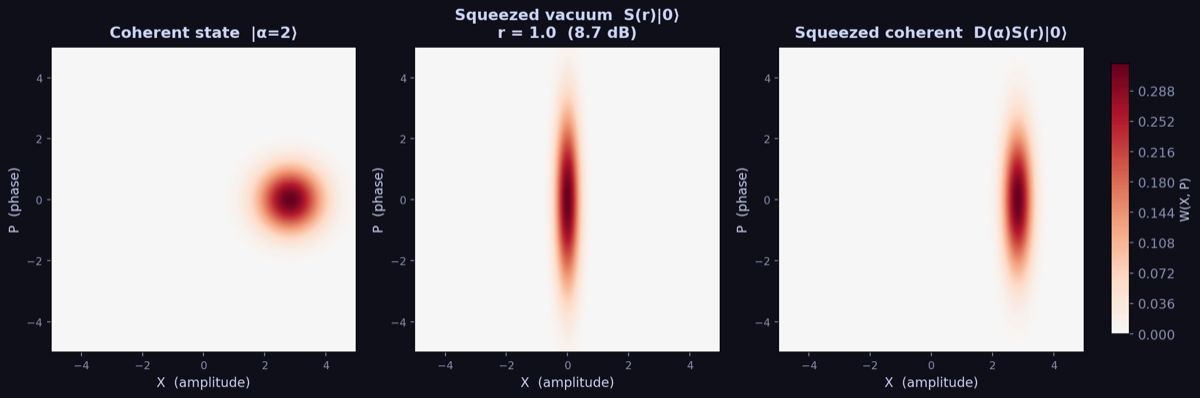
Waveguide squeezed light source
Build integrated nonlinear waveguide sources of squeezed light for compact, robust quantum-enhanced interferometry.
Learn more →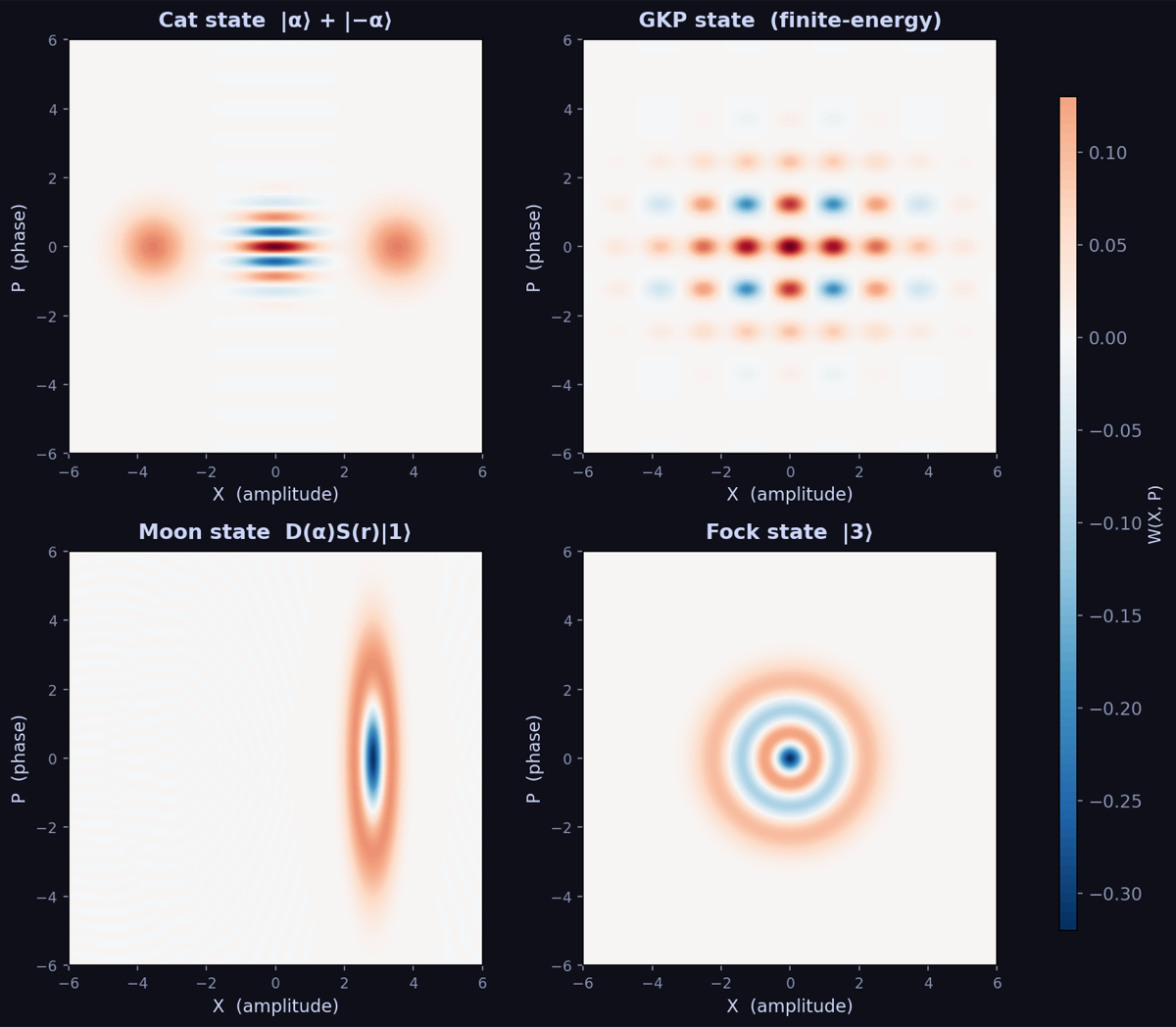
Quantum Control for Metrology using non-Gaussian states
Optimal state injection and readout for precision measurement — preparing non-Gaussian quantum states (cat, GKP, photon-subtracted) that break through the Gaussian squeezing ceiling and extracting maximum Fisher information from them.
Learn more →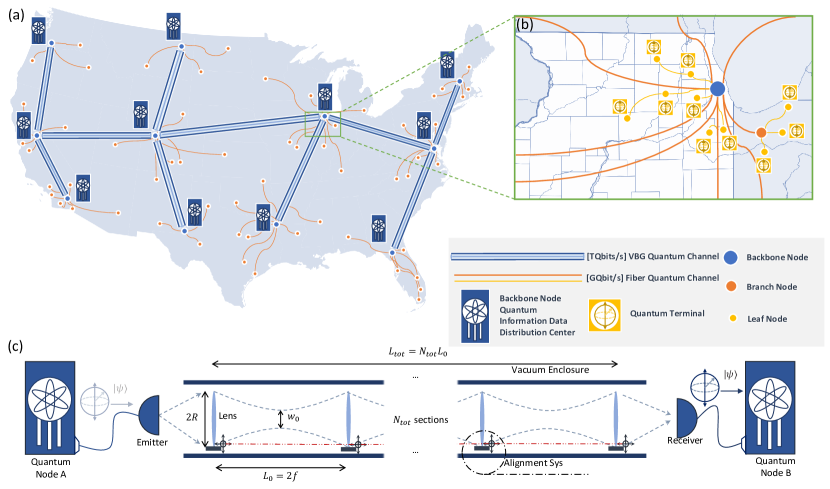
Vacuum Beam Guide
Build and characterize a long-baseline vacuum beam guide as a quantum link between laboratories for interferometry and quantum networking.
Learn more →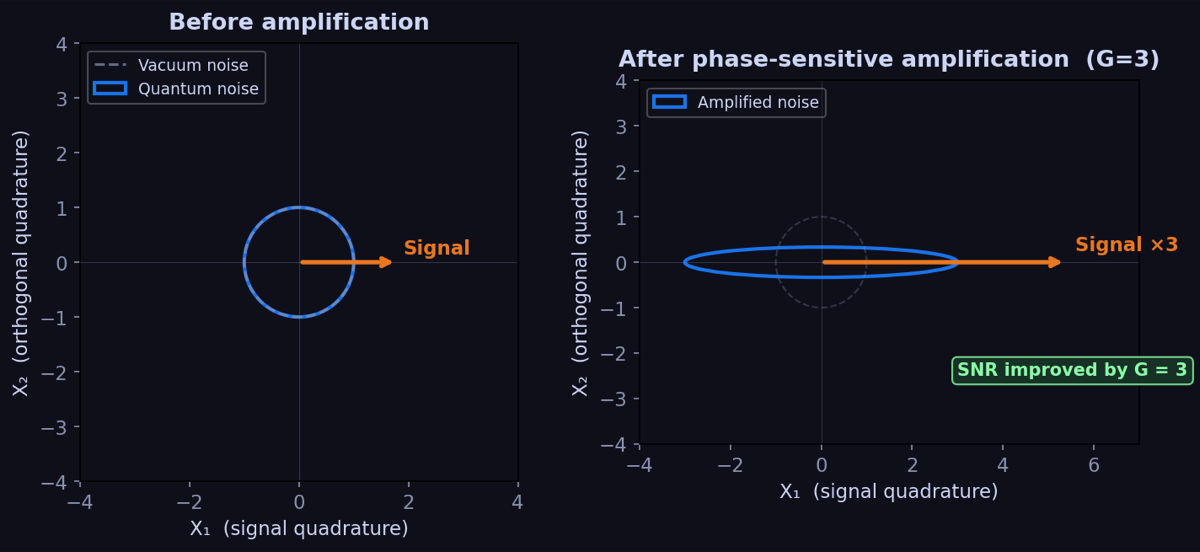
Phase-Sensitive Optomechanical Amplifier (PSOMA)
An optomechanical amplifier that uses phase-sensitive gain to boost gravitational-wave signals below the standard quantum limit, targeting the radiation-pressure-dominated low-frequency band.
Learn more →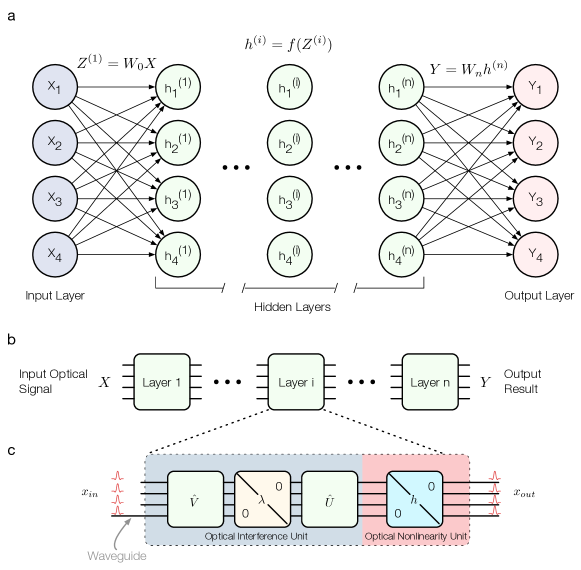
Quantum Neural Networks for Optimal Coherent Control
Parameterized quantum circuits and photonic neural networks that learn optimal coherent control strategies for precision measurement, closing the gap between achieved sensitivity and fundamental quantum bounds.
Learn more →Selected Publications
Key papers from the group on quantum measurement, squeezing, and precision limits.
-
2023 Broadband Quantum Enhancement of the LIGO Detectors with Frequency-Dependent Squeezing, Physical Review X.
D. Ganapathy, W. Jia, M. Nakano, V. Xu, and N. Aritomi, et al.Abstract
Quantum noise imposes a fundamental limitation on the sensitivity of interferometric gravitational-wave detectors like LIGO, manifesting as shot noise and quantum radiation pressure noise. Here, we present the first realization of frequency-dependent squeezing in full-scale gravitational-wave detectors, resulting in the reduction of both shot noise and quantum radiation pressure noise, with broadband detector enhancement from tens of hertz to several kilohertz. In the LIGO Hanford detector, squeezing reduced the detector noise amplitude by a factor of 1.6 (4.0 dB) near 1 kHz;...
-
2024 Quantum Precision Limits of Displacement Noise-Free Interferometers, Physical Review Letters.
Tuvia Gefen, Rajashik Tarafder, Rana X. Adhikari, and Yanbei ChenAbstract
Current laser-interferometric gravitational wave detectors suffer from a fundamental limit to their precision due to the displacement noise of optical elements contributed by various sources. Several schemes for displacement noise-free interferometers (DFI) have been proposed to mitigate their effects. The idea behind these schemes is similar to decoherence-free subspaces in quantum sensing; i.e., certain modes contain information about the gravitational waves but are insensitive to the mirror motion (displacement noise). We derive quantum precision limits for general DFI schemes, including...
-
2020 Quantum correlations between light and the kilogram-mass mirrors of LIGO, Nature.
Haocun Yu, L. McCuller, M. Tse, L. Barsotti, and N. Mavalvala, et al.Abstract
The measurement of minuscule forces and displacements with ever greater precision is inhibited by the Heisenberg uncertainty principle, which imposes a limit to the precision with which the position of an object can be measured continuously, known as the standard quantum limit. When light is used as the probe, the standard quantum limit arises from the balance between the uncertainties of the photon radiation pressure applied to the object and of the photon number in the photoelectric detection. The only...
-
2020 Phase-sensitive optomechanical amplifier for quantum noise reduction in laser interferometers, Physical Review A.
Yuntao Bai, Gautam Venugopalan, Kevin Kuns, Christopher Wipf, Aaron Markowitz, Andrew R. Wade, Yanbei Chen, and Rana X. AdhikariAbstract
The sensitivity of future gravitational wave interferometers is expected to be limited throughout the detection band by quantum vacuum fluctuations, which can be reduced by applying quantum optics techniques such as squeezed vacuum injection. However, decoherence caused by optical losses in the readout chain will severely limit the effectiveness of such schemes. It was proposed that effect of losses in the final stage of detection can be mitigated by a phase-sensitive amplifier placed in between the output port of the...
-
2022 Exposing gravitational waves below the quantum sensing limit, Physical Review D.
Hang Yu, Denis Martynov, Rana X. Adhikari, and Yanbei ChenAbstract
The sensitivities of ground-based gravitational-wave (GW) detectors are limited by quantum shot noise at a few hundred hertz and above. Nonetheless, one can use a quantum-correlation technique proposed by Martynov et al. [Phys. Rev. A 95, 043831 (2017) to remove the expectation value of the shot noise, thereby exposing underlying classical signals in the cross spectrum formed by cross-correlating the two outputs in a GW interferometer's antisymmetric port. We explore here the prospects and analyze the sensitivity of using quantum...
-
2022 Optimizing gravitational-wave detector design for squeezed light, Physical Review D.
Jonathan W. Richardson, Swadha Pandey, Edita Bytyqi, Tega Edo, and Rana X. AdhikariAbstract
Achieving the quantum noise targets of third-generation detectors will require 10 dB of squeezed-light enhancement as well as megawatt laser power in the interferometer arms—both of which require unprecedented control of the internal optical losses. In this work, we present a novel optimization approach to gravitational-wave detector design aimed at maximizing the robustness to common, yet unavoidable, optical fabrication and installation errors, which have caused significant loss in Advanced LIGO. As a proof of concept, we employ these techniques to...
-
2021 LIGO's quantum response to squeezed states, Physical Review D.
L. McCuller, S. E. Dwyer, A. C. Green, Haocun Yu, and K. Kuns, et al.Abstract
Gravitational wave interferometers achieve their profound sensitivity by combining a Michelson interferometer with optical cavities, suspended masses, and now, squeezed quantum states of light. These states modify the measurement process of the LIGO, VIRGO and GEO600 interferometers to reduce the quantum noise that masks astrophysical signals; thus, improvements to squeezing are essential to further expand our gravitational view of the Universe. Further reducing quantum noise will require both lowering decoherence from losses as well more sophisticated manipulations to counter the...
-
2019 Quantum-Enhanced Advanced LIGO Detectors in the Era of Gravitational-Wave Astronomy, Physical Review Letters.
M. Tse, F. Matichard, R. Abbott, R. X. Adhikari, and A. Ananyeva, et al.Abstract
The Laser Interferometer Gravitational Wave Observatory (LIGO) has been directly detecting gravitational waves from compact binary mergers since 2015. We report on the first use of squeezed vacuum states in the direct measurement of gravitational waves with the Advanced LIGO H1 and L1 detectors. This achievement is the culmination of decades of research to implement squeezed states in gravitational-wave detectors. During the ongoing O3 observation run, squeezed states are improving the sensitivity of the LIGO interferometers to signals above 50...