
Image: MJ Doherty / Caltech/MIT/LIGO Lab
General relativity and quantum mechanics are the twin pillars of modern physics, yet they remain fundamentally unreconciled. We pursue tabletop experiments that probe this frontier — not by building particle accelerators, but by pushing optomechanical systems to regimes where quantum and gravitational effects might intersect.
Our philosophy is rigorously empirical. We design null experiments: measurements where standard physics predicts a precise null result, so any deviation would signal new physics. Candidate targets include spacetime discreteness at the Planck scale, gravitationally induced decoherence, and exotic noise sources predicted by various quantum-gravity models. The experimental toolkit spans cryogenic mechanical oscillators cooled to their quantum ground states, high-finesse optical cavities for attometer-level displacement sensing, and correlation measurements between spatially separated masses.
We collaborate closely with theorists to ensure our experiments actually constrain the models we care about — not just technically impressive, but scientifically decisive. Reproducibility is a core value: we document protocols in detail, share data openly, and encourage independent replication at partner laboratories worldwide.
Active Projects
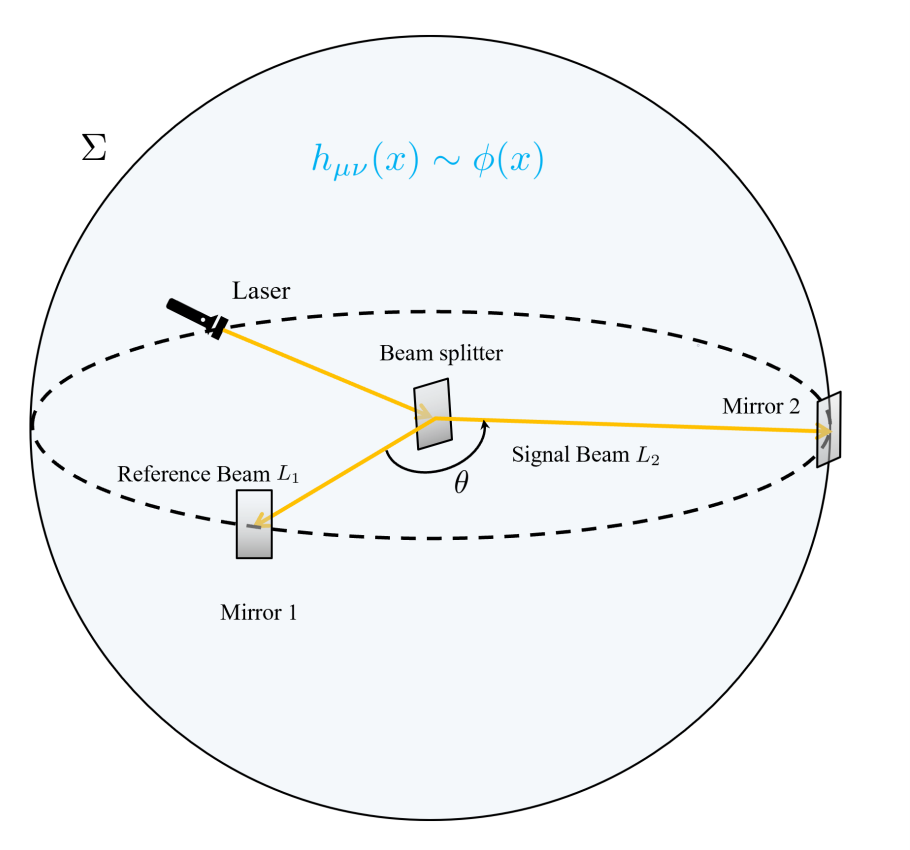
Tabletop tests of quantum gravity
Design tabletop optomechanical experiments that probe quantum aspects of gravity and potential deviations from standard quantum mechanics.
Learn more →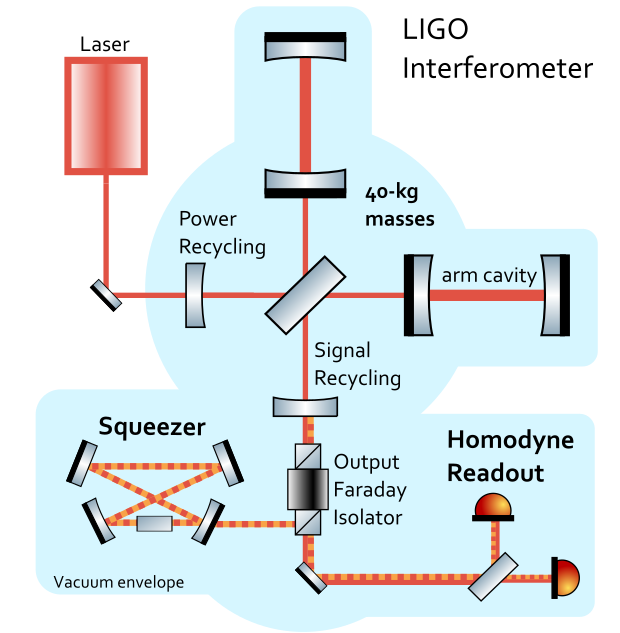
Precision Optomechanical Platforms
Kilogram-scale mirrors with attometer-level readout sensitivity, repurposed from gravitational-wave detection to probe quantum mechanics at macroscopic scales and test quantum-gravity predictions.
Learn more →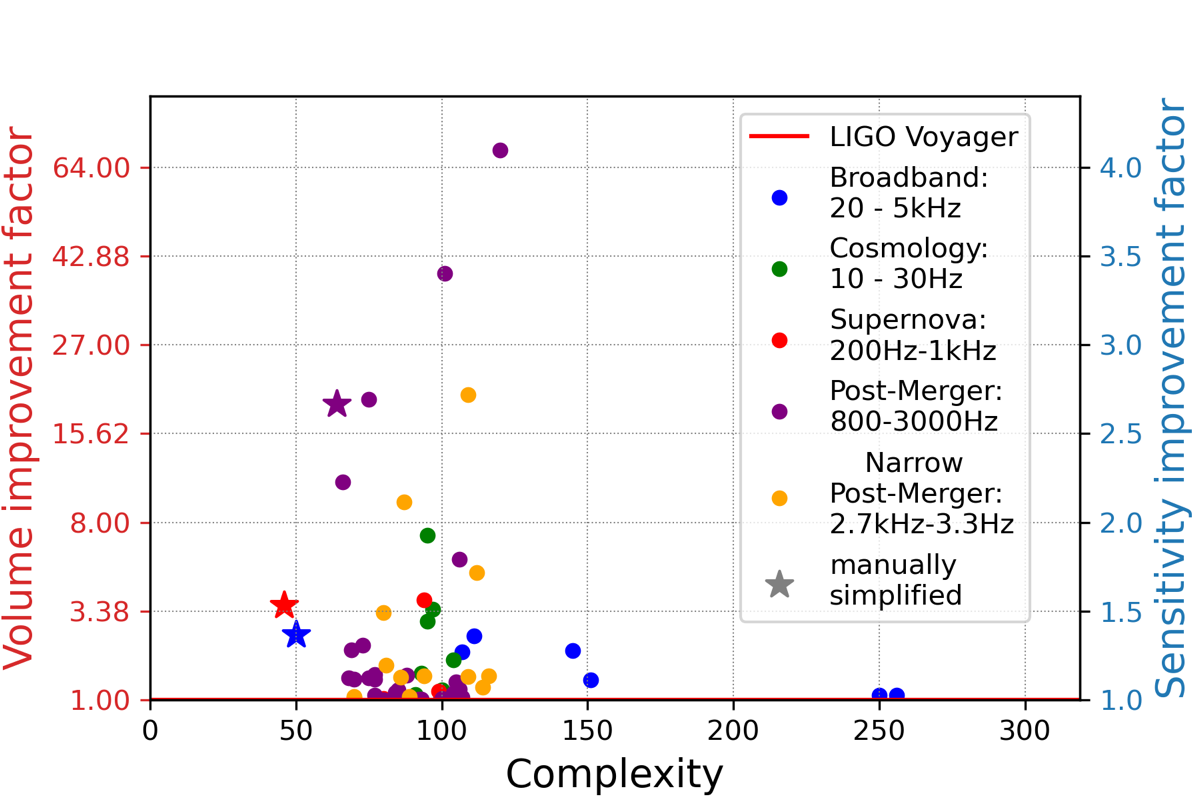
Computational Experiment Design
Using optimization and computational search to design experiments that maximize sensitivity to quantum-gravity signatures, systematically exploring interferometer topologies and measurement protocols.
Learn more →Historical Context
Experimental quantum gravity phenomenology has a rich history stretching from Einstein's general relativity through the holographic principle to today's precision laboratory tests. Our work builds on decades of theoretical and experimental development across multiple subfields.
Selected Publications
Key papers on quantum gravity tests, foundational physics, and precision measurement at the quantum-gravity interface.
-
2024 Quantum Precision Limits of Displacement Noise-Free Interferometers, Physical Review Letters.
Tuvia Gefen, Rajashik Tarafder, Rana X. Adhikari, and Yanbei ChenAbstract
Current laser-interferometric gravitational wave detectors suffer from a fundamental limit to their precision due to the displacement noise of optical elements contributed by various sources. Several schemes for displacement noise-free interferometers (DFI) have been proposed to mitigate their effects. The idea behind these schemes is similar to decoherence-free subspaces in quantum sensing; i.e., certain modes contain information about the gravitational waves but are insensitive to the mirror motion (displacement noise). We derive quantum precision limits for general DFI schemes, including...
-
2022 Exposing gravitational waves below the quantum sensing limit, Physical Review D.
Hang Yu, Denis Martynov, Rana X. Adhikari, and Yanbei ChenAbstract
The sensitivities of ground-based gravitational-wave (GW) detectors are limited by quantum shot noise at a few hundred hertz and above. Nonetheless, one can use a quantum-correlation technique proposed by Martynov et al. [Phys. Rev. A 95, 043831 (2017) to remove the expectation value of the shot noise, thereby exposing underlying classical signals in the cross spectrum formed by cross-correlating the two outputs in a GW interferometer's antisymmetric port. We explore here the prospects and analyze the sensitivity of using quantum...
-
2015 Towards the Laboratory Search for Space-Time Dissipation, .
Huan Yang, Larry R. Price, Nicholas D. Smith, Rana X. Adhikari, Haixing Miao, and Yanbei ChenAbstract
It has been speculated that gravity could be an emergent phenomenon, with classical general relativity as an effective, macroscopic theory, valid only for classical systems at large temporal and spatial scales. As in classical continuum dynamics, the existence of underlying microscopic degrees of freedom may lead to macroscopic dissipative behaviors. With the hope that such dissipative behaviors of gravity could be revealed by carefully designed experiments in the laboratory, we consider a phenomenological model that adds dissipations to the gravitational...
-
2020 Quantum correlations between light and the kilogram-mass mirrors of LIGO, Nature.
Haocun Yu, L. McCuller, M. Tse, L. Barsotti, and N. Mavalvala, et al.Abstract
The measurement of minuscule forces and displacements with ever greater precision is inhibited by the Heisenberg uncertainty principle, which imposes a limit to the precision with which the position of an object can be measured continuously, known as the standard quantum limit. When light is used as the probe, the standard quantum limit arises from the balance between the uncertainties of the photon radiation pressure applied to the object and of the photon number in the photoelectric detection. The only...
-
2020 Phase-sensitive optomechanical amplifier for quantum noise reduction in laser interferometers, Physical Review A.
Yuntao Bai, Gautam Venugopalan, Kevin Kuns, Christopher Wipf, Aaron Markowitz, Andrew R. Wade, Yanbei Chen, and Rana X. AdhikariAbstract
The sensitivity of future gravitational wave interferometers is expected to be limited throughout the detection band by quantum vacuum fluctuations, which can be reduced by applying quantum optics techniques such as squeezed vacuum injection. However, decoherence caused by optical losses in the readout chain will severely limit the effectiveness of such schemes. It was proposed that effect of losses in the final stage of detection can be mitigated by a phase-sensitive amplifier placed in between the output port of the...