Quantum Control for Metrology using non-Gaussian states
Optimal state injection and readout for precision measurement — preparing non-Gaussian quantum states (cat, GKP, photon-subtracted) that break through the Gaussian squeezing ceiling and extracting maximum Fisher information from them.
Gallery
Research area
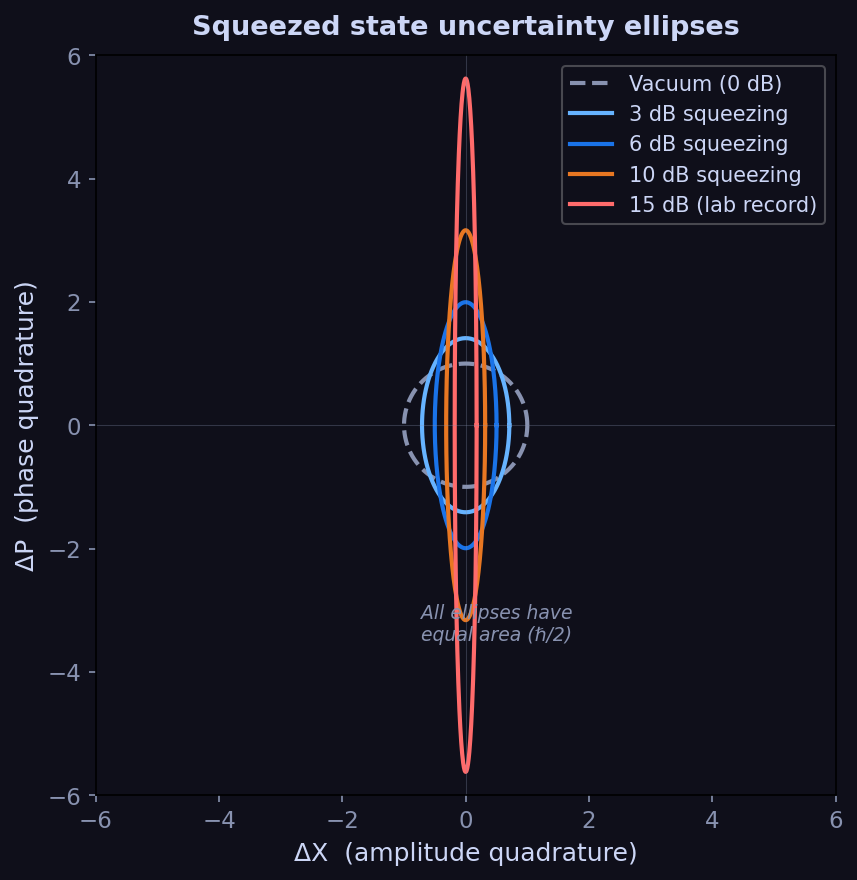
Squeezed states of light have pushed gravitational-wave detectors beyond the standard quantum limit — reducing quantum noise by a factor of 2 (6 dB) across the LIGO measurement band. But squeezed states are Gaussian: their quantum uncertainties form ellipses in phase space, and their Wigner functions are everywhere non-negative. This Gaussianity is both their practical strength (easy to produce, easy to model) and their fundamental ceiling. For certain measurement tasks, no Gaussian state — no matter how strongly squeezed — can saturate the quantum Cramér-Rao bound.
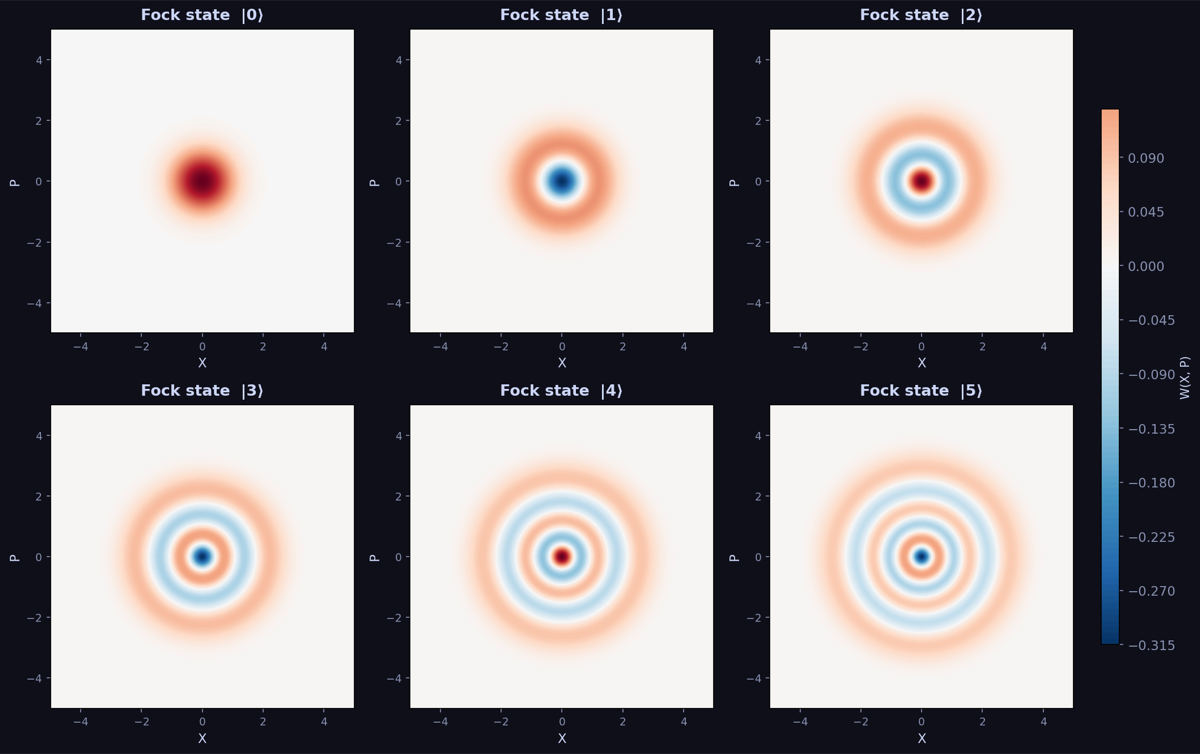
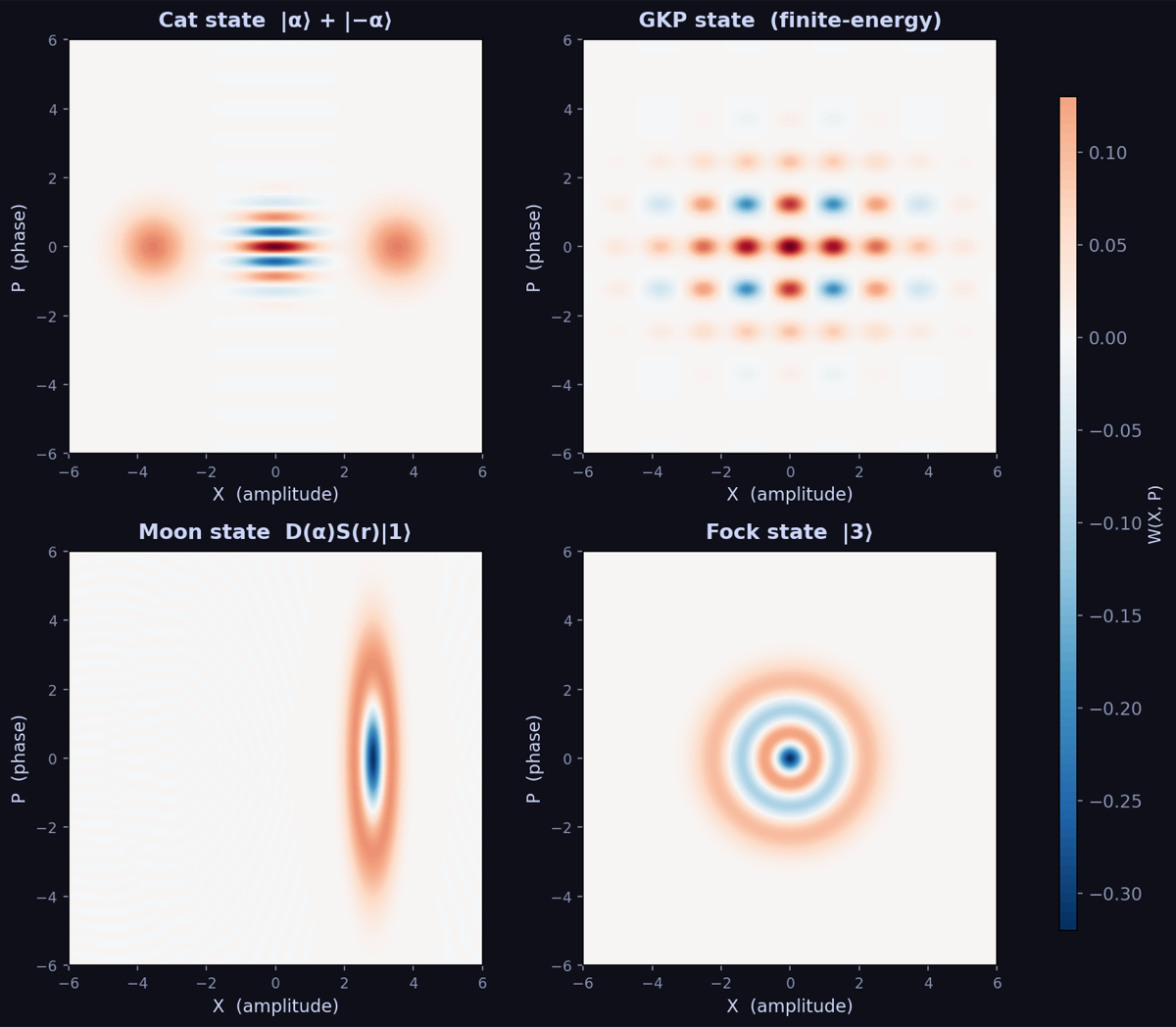
Non-Gaussian states break through this ceiling. Cat states, GKP states, photon-subtracted squeezed states, and Fock states carry quantum information in phase-space structures that Gaussian states cannot access — interference fringes, lattice patterns, discrete photon-number distributions. The price: they are fragile, probabilistic to prepare, and demand non-standard detection schemes to read out. This project develops the quantum control techniques to prepare the optimal quantum state for a given measurement task and extract the maximum information from it.
Contents:
- The Gaussian ceiling
- Non-Gaussian states for metrology
- State injection protocols
- Fisher information analysis
- Readout optimization
- Loss tolerance
- Competing approaches
- The LIGO context
- Connections to other fields
- Our contributions
- Current status and future directions
- Key references
- Further reading
The Gaussian ceiling
Why squeezed states hit a wall
A squeezed vacuum state has a Wigner function:
\[W(x,p) = \frac{2}{\pi}\exp\!\left(-2e^{2r}x^2 - 2e^{-2r}p^2\right)\]where $r$ is the squeezing parameter. The noise in one quadrature ($x$) is reduced by $e^{-r}$, at the cost of amplifying the other ($p$) by $e^{+r}$. This is the Heisenberg trade-off for Gaussian states.
The problem is loss. When a squeezed state passes through an optical element with transmission $\eta$, the output state is:
\[\hat{\rho}_\text{out} = \text{Tr}_E\!\left[U_\text{BS}(\eta)\,(\hat{\rho}_\text{sq}\otimes|0\rangle\langle 0|)\,U_\text{BS}^\dagger(\eta)\right]\]where vacuum noise enters through the unused port. The detected squeezing level becomes:
\[S_\text{detected} = \eta\, e^{-2r} + (1-\eta)\]As $r$ increases, the first term shrinks — but the second term (vacuum noise from loss) stays fixed. The detected squeezing saturates at $S_\text{min} = 1 - \eta$ regardless of how hard you squeeze. For 5% total loss ($\eta = 0.95$), the maximum detectable squeezing is $-10\log_{10}(0.05) \approx 13$ dB — even with infinite input squeezing.
Gaussian state formalism and the Williamson decomposition
A Gaussian state of $N$ modes is completely characterized by its first moments (displacements, easily removed) and its $2N \times 2N$ covariance matrix:
\[\boldsymbol{\sigma}_{jk} = \frac{1}{2}\langle\{\hat{R}_j - \langle\hat{R}_j\rangle,\, \hat{R}_k - \langle\hat{R}_k\rangle\}\rangle\]where $\hat{\mathbf{R}} = (\hat{x}_1, \hat{p}_1, \ldots, \hat{x}_N, \hat{p}_N)$. The uncertainty principle requires $\boldsymbol{\sigma} + \frac{i}{2}\boldsymbol{\Omega} \geq 0$, where $\boldsymbol{\Omega}$ is the symplectic form.
Williamson’s theorem: Any positive-definite matrix $\boldsymbol{\sigma}$ can be diagonalized by a symplectic transformation $S$:
\[S\,\boldsymbol{\sigma}\, S^T = \text{diag}(\nu_1, \nu_1, \nu_2, \nu_2, \ldots, \nu_N, \nu_N)\]The $\nu_k$ are the symplectic eigenvalues. For a physical state, $\nu_k \geq 1/2$. For a pure Gaussian state (including pure squeezed states), all $\nu_k = 1/2$ — squeezing is reflected in the anisotropy of the covariance matrix, not in the symplectic eigenvalues. For mixed states, $\nu_k > 1/2$ indicates thermal noise. Gaussian operations transform the covariance matrix via symplectic matrices but cannot create the higher-order phase-space structures (interference fringes, Wigner negativity) that characterize non-Gaussian states.
The Gaussian ceiling, formally: The maximum Fisher information achievable with a Gaussian state and Gaussian measurement (homodyne/heterodyne) is bounded by a function of the covariance matrix. Non-Gaussian states can exceed this bound because their Wigner functions carry information in higher-order phase-space structures — interference fringes, negativity — that the covariance matrix cannot capture.
Non-Gaussian states for metrology
Cat states
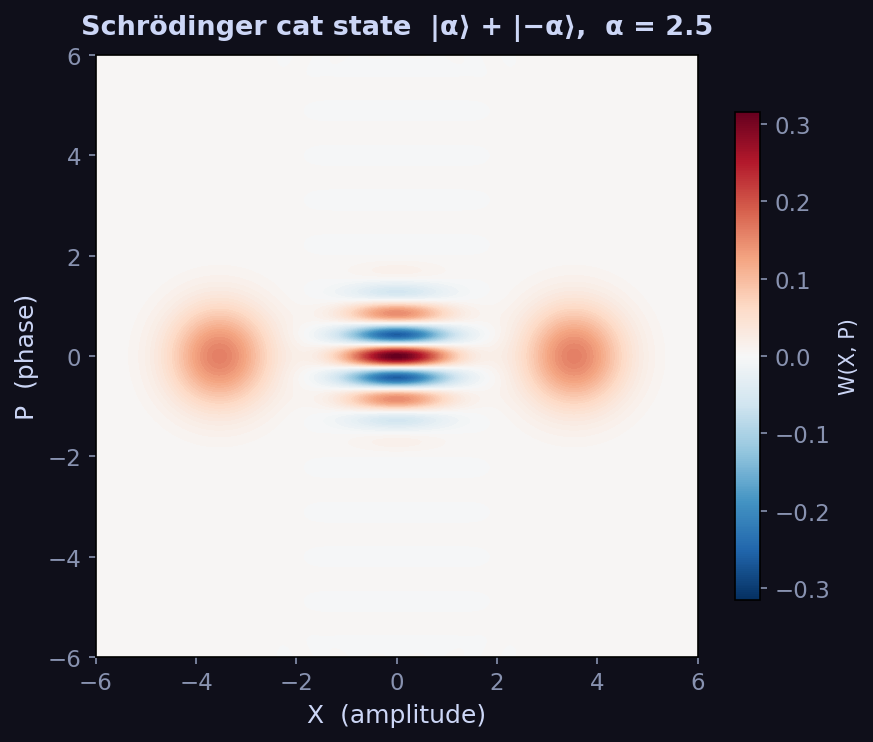
The Schrödinger cat state is a superposition of two coherent states:
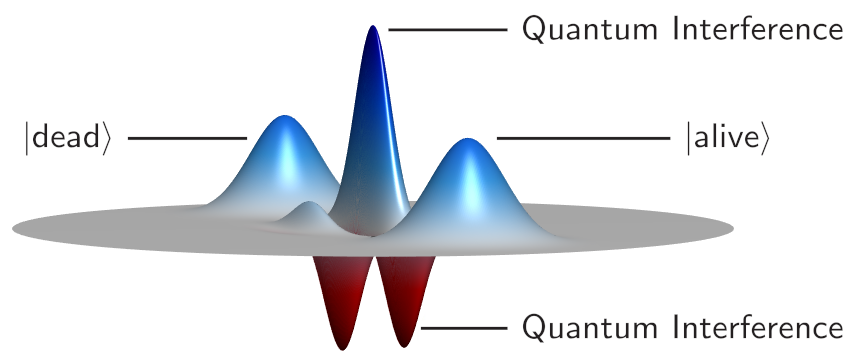
\[|\text{cat}_\pm\rangle = \mathcal{N}_\pm\!\left(|\alpha\rangle \pm |-\alpha\rangle\right)\]where $\mathcal{N}_\pm$ is a normalization constant. The $+$ (even) cat has only even photon numbers; the $-$ (odd) cat has only odd. The Wigner function shows two Gaussian peaks (the “alive” and “dead” cat) connected by quantum interference fringes — oscillations that can be finer than any Gaussian feature.
| Metrological advantage: For displacement estimation, the QFI of a cat state scales as $F_Q \sim | \alpha | ^2$ for small displacements (same as coherent) but the Fisher information per photon is higher because the interference fringes provide sharper phase sensitivity. For specific phase estimation tasks, cat states approach Heisenberg scaling. |
GKP states
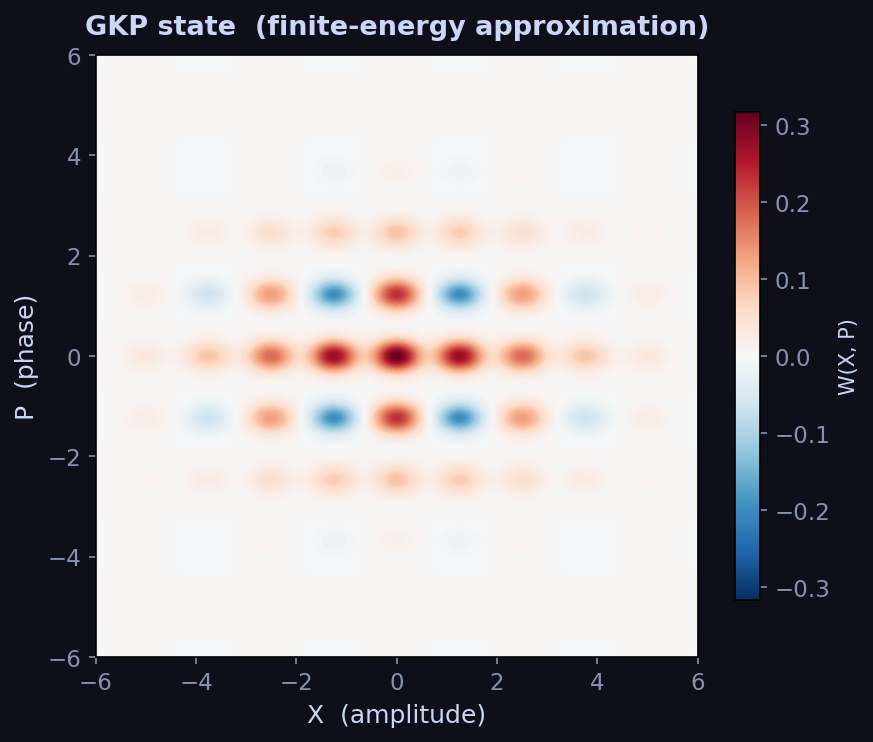
The Gottesman-Kitaev-Preskill state has a Wigner function that forms a periodic lattice in phase space:
\[W_\text{GKP}(x,p) \propto \sum_{s,t \in \mathbb{Z}} (-1)^{st}\, e^{-\frac{(x-s\sqrt{\pi})^2}{2\Delta^2}} \, e^{-\frac{(p-t\sqrt{\pi})^2}{2\Delta^2}}\]where $\Delta$ is the envelope width (a practical approximation of the ideal infinite-energy GKP state). The lattice structure provides intrinsic error correction against small displacements — a feature unique to GKP states.
Metrological advantage: GKP states can detect displacements with a precision set by the lattice spacing ($\sqrt{\pi}$ in natural units), regardless of the overall state size. This provides a fundamentally different scaling from Gaussian states, and makes GKP states naturally robust to a class of errors that destroys cat-state advantages.
Photon-subtracted squeezed states
| The simplest non-Gaussian operation on a Gaussian state: remove one photon from a squeezed vacuum. The resulting state $\hat{a} | r\rangle$ has a Wigner function with a central negative dip — a definitive signature of non-classicality. |
Metrological advantage: Photon-subtracted squeezed states have higher Fisher information per photon than the parent squeezed state for displacement estimation. Ourjoumtsev et al. (2006) demonstrated photon subtraction for cat-state generation, and Namekata et al. (2010) demonstrated PNR-based photon subtraction at telecom wavelengths. The advantage is modest (~20-50% more Fisher information per photon) but achievable with current technology.
Fock states and moon states
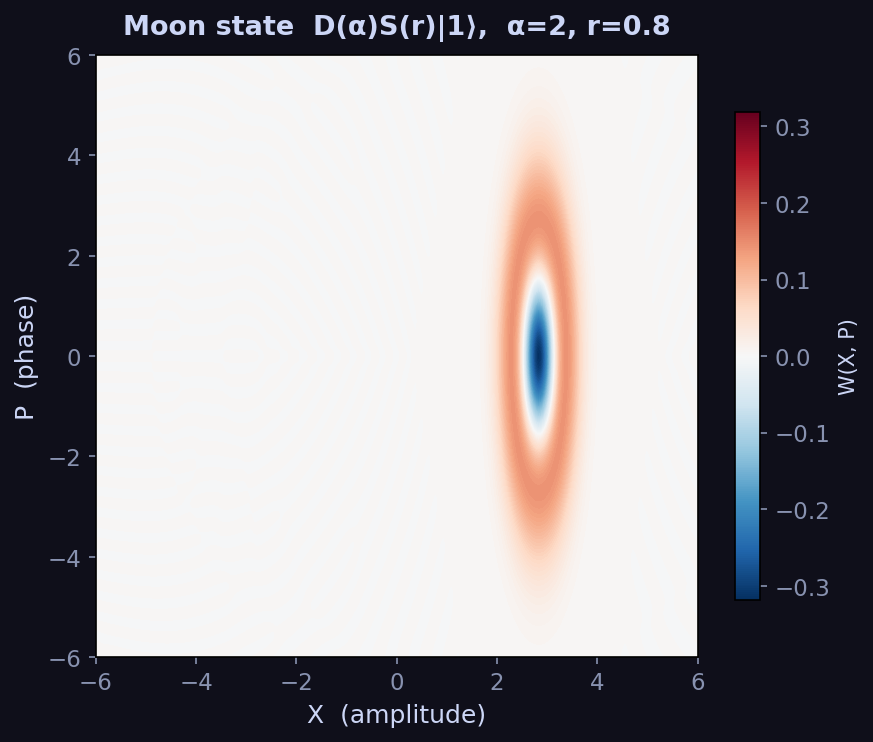
| Fock states $ | n\rangle$ (definite photon number) and moon states (displaced squeezed Fock states) round out the non-Gaussian toolbox. In appropriate interferometric configurations, Fock states achieve phase sensitivity that scales quadratically with photon number — approaching the Heisenberg limit — but they are extremely difficult to prepare at high $n$. |
Moon states, named for their crescent-shaped Wigner functions, combine the practical advantages of displacement and squeezing with the non-Gaussian structure of a Fock state core.
State injection protocols
Photon subtraction
The workhorse of non-Gaussian state preparation: tap off a small fraction of a squeezed beam with a low-reflectivity beamsplitter and detect a photon in the reflected arm with a single-photon detector. Conditional on detecting a click, the transmitted beam is in a photon-subtracted squeezed state.
The conditional state depends on the tap ratio $R$:
- $R \ll 1$: High-fidelity single-photon subtraction, but low success probability ($P \sim R \bar{n}_\text{sq}$)
- Larger $R$: Higher success rate but multi-photon contamination degrades the non-Gaussian character
For squeezed vacuum with 10 dB squeezing and $R = 1\%$, the success probability is $\sim 0.1$ per pulse — feasible at MHz repetition rates.
Photon addition
The conjugate operation: inject a single photon into a mode containing a squeezed state using stimulated emission or a nonlinear interaction. Photon addition creates states with higher mean energy than photon subtraction and can achieve higher Fisher information, but is experimentally more challenging.
Zavatta et al. (2004) demonstrated single-photon addition to a coherent state; combining this with squeezed state inputs is an active research direction.
Conditional preparation with PNR detectors
Photon-number-resolving (PNR) detectors enable more sophisticated state engineering:
- Multi-photon subtraction: Conditioning on $n > 1$ photon detections creates higher-order non-Gaussian states with larger Wigner negativity
- Heralded cat states: A two-mode squeezed vacuum state, with PNR detection on one mode, heralds approximate cat states on the other mode (Ourjoumtsev et al. 2006, Neergaard-Nielsen et al. 2006)
- GKP state breeding: Iterative entangling operations and homodyne measurements on multiple squeezed states can produce approximate GKP states (Vasconcelos et al. 2010; Tzitrin et al. 2020)
Transition-edge sensor (TES) detectors resolve photon number up to ~20 with >95% quantum efficiency. Superconducting nanowire detectors (SNSPDs) with multiplexed readout can achieve effective PNR capability at higher rates.
Breeding protocols for GKP states
Generating GKP states requires building up the periodic lattice structure iteratively:
- Start with $N$ copies of squeezed vacuum
- Entangle pairs using beamsplitters: each pair becomes a two-mode squeezed state
- Measure one mode of each pair with homodyne detection
- Post-select on measurement outcomes near $\sqrt{\pi}\mathbb{Z}$ (the lattice points)
- The unmeasured modes are approximate GKP states — with quality that improves with the number of rounds
The success probability decreases exponentially with the number of rounds, but each successful round improves the lattice quality (smaller $\Delta$). Tzitrin et al. (2020) showed that with 10–20 squeezed states and reasonable post-selection thresholds, GKP states with $\Delta \lesssim 0.3$ (sufficient for error correction) are achievable.
Key bottleneck: The success probability for high-quality GKP states is $\sim 10^{-4}$ to $10^{-6}$. This may be acceptable for quantum computing (where you can wait for a successful preparation), but for continuous GW observation, the state must be prepared on demand. This tension between state quality and preparation rate is a central challenge.
Fisher information analysis
Which state is optimal for which measurement?
The choice of optimal quantum state depends on the measurement task:
| Measurement task | Optimal Gaussian state | Best non-Gaussian alternative | Advantage | ||
|---|---|---|---|---|---|
| Phase estimation (single frequency) | Squeezed vacuum | NOON state, $ | N,0\rangle + | 0,N\rangle$ | Heisenberg scaling: $1/N$ vs $1/\sqrt{N}$ |
| Displacement estimation | Squeezed coherent | Photon-subtracted squeezed | ~20-50% more $F_Q$ per photon | ||
| Broadband strain (GW detection) | Freq.-dep. squeezed vacuum | Cat state + adaptive readout | Depends on loss; breaks even at ~3% | ||
| Multi-parameter estimation | Multimode squeezed | Multimode cat / cluster | Enables simultaneous saturation of QCRB |
Fisher information calculation for cat states
| For a cat state $ | \text{cat}+\rangle = \mathcal{N}+!( | \alpha\rangle + | -\alpha\rangle)$ used for displacement estimation $\hat{D}(\delta) = e^{i\delta\hat{p}}$: |
The QFI for displacement $\delta$ is:
\[F_Q = 4\,\text{Var}(\hat{p})_\text{cat} = 4\left(\langle\hat{p}^2\rangle - \langle\hat{p}\rangle^2\right)\]For the even cat state with amplitude $\alpha$ (real):
\[\langle\hat{p}\rangle = 0\] \[\langle\hat{p}^2\rangle = \frac{1}{2} + |\alpha|^2 \cdot \frac{1 - e^{-2|\alpha|^2}}{1 + e^{-2|\alpha|^2}}\]| For large $ | \alpha | $: |
| The even cat state has mean photon number $\bar{n}_\text{cat} = | \alpha | ^2 \tanh( | \alpha | ^2) \approx | \alpha | ^2$ for large $ | \alpha | $. Comparing with a coherent state of the same mean photon number ($F_Q^\text{coherent} = 2$): the ratio $F_Q^\text{cat}/F_Q^\text{coherent} = (2 + 4 | \alpha | ^2)/2 \approx 2 | \alpha | ^2$ for large $ | \alpha | $ — a substantial improvement. |
The catch: This advantage is only realized if the measurement can resolve the interference fringes in the Wigner function. Homodyne detection averages over the fringes, recovering only the Gaussian contribution. A QNN-optimized readout (see QNN project) is needed to access the full Fisher information.
The loss penalty
Every non-Gaussian state is more sensitive to loss than its Gaussian counterpart. This is because loss — modeled as a beamsplitter with vacuum input — is a Gaussian operation that progressively erases non-Gaussian features:
-
Cat states: Interference fringes decay as $e^{-2\eta_\text{loss} \alpha ^2}$. For a cat with $ \alpha = 2$ and 5% loss, the fringe visibility drops by $\sim 33\%$. - GKP states: Lattice peaks broaden by $\Delta \to \sqrt{\Delta^2 + \eta_\text{loss}/2}$. Error correction capability degrades when $\Delta$ exceeds $\sim 0.3$.
-
Fock states: $ n\rangle$ becomes a mixture of $ 0\rangle$ through $ n\rangle$ after loss, with the non-Gaussian character encoded in the photon-number distribution.
The critical question: at what loss level does the non-Gaussian advantage disappear? The answer is state-dependent:
- Photon-subtracted squeezed states: advantage persists up to ~10% loss
-
Cat states ($ \alpha = 2$): advantage persists up to ~3-5% loss - GKP states: the most robust — error correction protects against loss up to ~10-15%
Current LIGO optical path has ~5% total loss (input optics, arm cavity, output optics, photodetector). This puts us right at the threshold for cat state advantage and comfortably within the regime for GKP and photon-subtracted states.
Readout optimization
Why non-Gaussian states need non-Gaussian measurements
A deep result in quantum estimation theory: for Gaussian states, homodyne detection is close to optimal (it saturates the QCRB for single-parameter estimation). But for non-Gaussian states, homodyne detection can be arbitrarily far from optimal.
The reason: homodyne measures marginal distributions of the Wigner function — projections onto a single axis. For a Gaussian state (which is fully characterized by its marginals), this captures all information. For a non-Gaussian state, the information is encoded in the joint distribution — interference fringes between different phase-space regions — which marginals cannot capture.
Measurement options
| Detection scheme | Measures | Optimal for | Current state of art |
|---|---|---|---|
| Homodyne | Single quadrature | Gaussian states, single parameter | Mature; used in LIGO |
| Heterodyne | Both quadratures (with 3 dB penalty) | Phase-insensitive tasks | Mature |
| Photon counting (PNR) | Photon number | Fock-state-like inputs | TES: ~95% QE, ~20 photon resolution |
| Adaptive homodyne | Time-varying quadrature | Transient signals | Demonstrated in tabletop experiments |
| Photon parity | Even/odd photon number | Cat states | Demonstrated with trapped ions |
| Modular measurement | $x \mod \sqrt{\pi}$ | GKP states | Theoretical; no experimental demo |
The QNN project addresses this problem systematically: a quantum neural network can learn the optimal measurement for a given input state and estimation task, without requiring the measurement to fit any of these standard categories.
Loss tolerance
The central challenge
Loss is the enemy of non-Gaussian quantum advantage. Every optical surface, every mode mismatch, every detector inefficiency adds vacuum noise that washes out non-Gaussian features. The question is not whether loss degrades performance — it always does — but whether non-Gaussian states can still outperform Gaussian states at the same loss level.
State-by-state comparison
Photon-subtracted squeezed vacuum: The most loss-tolerant non-Gaussian state for displacement estimation. The Fisher information advantage over squeezed vacuum degrades linearly with loss:
\[\frac{F_Q^\text{sub}}{F_Q^\text{sq}} \approx 1 + \frac{\eta\, e^{2r}}{1 + (1-\eta)e^{2r}}\]For 10 dB squeezing ($e^{2r} = 10$) and 5% loss, the ratio is $\sim 1.4$ — a 40% advantage, declining to $\sim 1.1$ at 15% loss.
Cat states: More fragile. The interference fringes that carry the metrological advantage are exponentially sensitive to loss:
\[\text{Fringe visibility} \propto e^{-2(1-\eta)|\alpha|^2}\]| For $ | \alpha | = 2$ (mean photon number $\sim 4$), fringe visibility drops to $e^{-0.4} \approx 0.67$ at 5% loss. The metrological advantage survives only for low loss or small cat amplitudes — precisely the regime where the advantage over Gaussian states is modest. |
GKP states: The most promising for loss-tolerant quantum advantage. The lattice structure provides discrete error correction: small displacements (from loss-induced vacuum noise) can be corrected if they are smaller than half the lattice spacing. This gives GKP states a threshold behavior — below a critical loss level, the non-Gaussian advantage is fully preserved; above it, it degrades gracefully.
The GKP error correction threshold for displacement noise is $\sigma < \sqrt{\pi}/2 \approx 0.89$ in natural units — displacements smaller than half the lattice spacing can be corrected. Converting this to a loss threshold depends on the finite-energy envelope $\Delta$ and the specific noise model; practical estimates for optical GKP states suggest robustness up to ~10-15% loss, which is more favorable than cat states at comparable amplitudes.
Competing approaches
Higher Gaussian squeezing
The simplest path: squeeze harder. Current best: 15 dB generated squeezing (Vahlbruch et al. 2016). Detected squeezing in LIGO: ~6 dB (limited by optical losses). Reducing losses is engineering; non-Gaussian states are physics. The two approaches are complementary — non-Gaussian operations applied to highly squeezed states give the best of both.
Back-action evasion (BAE)
Variational readout and speed meters avoid the SQL by measuring only the signal quadrature, evading radiation pressure back-action. BAE is a Gaussian technique — it uses squeezed light and modified interferometer topology — but it addresses the same goal: beating the SQL. BAE and non-Gaussian states are compatible: a BAE interferometer with non-Gaussian input states could outperform either alone.
Entanglement-enhanced strategies
Distributing entangled states across multiple detectors (or multiple frequency bands) can improve parameter estimation through quantum correlations. The SU(1,1) interferometer uses entangled photon pairs generated by parametric amplification. These strategies use non-classical but often Gaussian correlations — they complement non-Gaussian state injection.
Quantum error correction for metrology
QEC codes (Shor, Steane, surface codes) can protect quantum states against noise during the measurement process. For metrology, this means maintaining non-Gaussian quantum advantage even in the presence of loss. Zhou et al. (2018) proved that QEC can restore Heisenberg scaling in the presence of certain noise channels — but the overhead (number of ancilla modes, syndrome measurement complexity) may be prohibitive for near-term experiments.
GKP states blur the line between “non-Gaussian state for metrology” and “QEC code for metrology” — they are both simultaneously.
The LIGO context
Current squeezing performance
Advanced LIGO currently operates with frequency-dependent squeezing:
- Generated squeezing: ~11 dB at the squeezer output
- Detected squeezing: ~6 dB after all optical losses
- Frequency-dependent rotation: 300-meter filter cavity rotates squeeze angle from low to high frequencies
- Broadband improvement: Factor of ~2 in strain sensitivity across the full measurement band (10 Hz – 5 kHz)
This Gaussian quantum enhancement was a decade-long effort (Aasi et al. 2013, Tse et al. 2019, Ganapathy et al. 2023). Non-Gaussian states are the next step.
What non-Gaussian states would add
In the LIGO context, non-Gaussian states target two specific improvements:
-
Breaking the Gaussian loss ceiling: At the current 5% loss level, Gaussian squeezing is limited to ~13 dB detected. Non-Gaussian states — particularly GKP states — can operate beyond this ceiling through error correction.
-
Multiparameter advantage: Current homodyne readout extracts one quadrature of the GW signal. Non-Gaussian states + non-Gaussian readout (see QNN project) could extract information from both quadratures simultaneously, improving multi-messenger parameter estimation (sky localization, mass ratio, spin).
Practical path to the detector
The path from lab demonstration to LIGO deployment has clear milestones:
- Lab-scale proof of principle: Demonstrate that a non-Gaussian state (photon-subtracted squeezed vacuum) injected into a tabletop interferometer produces measurably lower noise than the same squeezed state without subtraction.
- PNR detector integration: Demonstrate photon-number-resolving detection at the audio frequencies (10–100 Hz) relevant for GW detection. Current PNR detectors operate at MHz; frequency bridging via electro-optic modulation may be needed.
- Loss budget demonstration: Show that non-Gaussian advantage survives at the 5% loss level of LIGO’s injection path.
- Full-scale test: Inject non-Gaussian states into a LIGO-like interferometer (possibly the 40-meter prototype at Caltech) and demonstrate improved sensitivity.
Connections to other fields
Quantum Computing (GKP Codes)
GKP states are among the most promising bosonic codes for fault-tolerant quantum computing. Google, AWS, and Yale are developing superconducting microwave GKP qubits. Progress in GKP state preparation for computing directly transfers to GKP states for metrology — the same states, different applications. Campagne-Ibarcq et al. (2020) demonstrated GKP qubit stabilization in a superconducting cavity.
Quantum Networks
Non-Gaussian states are essential resources for quantum repeaters: entanglement distillation protocols require non-Gaussian operations (photon subtraction, noiseless amplification) to concentrate entanglement from noisy distributed states. Techniques developed for GW detector state injection apply directly to quantum network node preparation.
Atomic Clocks
Optical lattice clocks and atomic fountain clocks face the same quantum projection noise limit as GW detectors. Squeezed spin states (the atomic analog of squeezed light) are already deployed. Non-Gaussian spin states — spin cat states, oversqueezed states — are the atomic analog of optical non-Gaussian states and offer the same metrological advantages. (Hosten et al. 2016)
Optomechanics
Macroscopic mechanical oscillators can be prepared in non-Gaussian quantum states via conditional measurement — detecting a phonon heralded by an anti-Stokes photon. The precision optomechanical platforms project explores quantum state preparation of kilogram-scale mirrors — the most massive objects in which quantum behavior has been observed.
Quantum Thermodynamics
Wigner negativity — the hallmark of non-Gaussianity — has been identified as a thermodynamic resource: states with negative Wigner functions can extract more work from thermal baths than any classical or Gaussian state (Albarelli, Genoni & Paris 2018). This connects the metrological value of non-Gaussian states to fundamental thermodynamics.
Our contributions
-
Quantum correlations in LIGO (Yu, Adhikari, et al. 2020) — Observed quantum correlations between the 40 kg mirrors and light in Advanced LIGO — demonstrating quantum measurement in the regime where non-Gaussian state injection would operate.
-
Optimizing detector design for squeezed light (Richardson, Pandey, et al. 2022) — Analyzed how interferometer design parameters affect the coupling of squeezed states, informing the optimal injection path for both Gaussian and non-Gaussian states.
-
LIGO’s quantum response (McCuller, Dwyer, et al. 2021) — Characterized LIGO’s quantum response to squeezed states, establishing the baseline for understanding how the detector would respond to non-Gaussian inputs.
-
Quantum-enhanced Advanced LIGO (Tse et al. 2019) — Demonstrated quantum-enhanced sensitivity in Advanced LIGO using squeezed light — the Gaussian foundation on which non-Gaussian enhancement builds.
-
Broadband quantum enhancement (Ganapathy et al. 2023) — Frequency-dependent squeezing in LIGO: broadband Gaussian quantum enhancement, establishing the state of the art that non-Gaussian states aim to surpass.
-
Enhanced sensitivity with squeezed light (Aasi et al. 2013) — Early demonstration of squeezed light injection in a GW detector, proving that quantum light enhancement works at observatory scale.
-
PSOMA (Bai, Venugopalan, …, Chen & Adhikari 2020) — The phase-sensitive optomechanical amplifier provides a new tool for quantum state manipulation at the detector output — potentially enabling non-Gaussian state generation within the interferometer itself.
-
Fundamental quantum limit (Miao, Adhikari, et al. 2017) — Established the fundamental quantum limit for linear measurements of classical forces — the theoretical ceiling that non-Gaussian states approach.
-
Cramér-Rao bound calibration (Hall, Cahillane, et al. 2019) — Applied quantum estimation theory to LIGO calibration, connecting the Cramér-Rao framework to practical detector operation.
Current status and future directions
Current status: The non-Gaussian metrology project is in the theoretical analysis and experimental planning phase:
- Quantifying the Fisher information advantage of specific non-Gaussian states for GW signal parameters under realistic loss models
- Designing a tabletop proof-of-principle experiment using photon-subtracted squeezed states
- Evaluating PNR detector technologies (TES, SNSPDs with multiplexing) for compatibility with GW readout requirements
Near-term goals:
- Demonstrate photon subtraction from a squeezed beam at audio-frequency sideband frequencies relevant to GW detection
- Measure the Fisher information of a photon-subtracted state in a tabletop Michelson and compare to the parent Gaussian state
- Develop numerical tools for computing multiparameter QFI for arbitrary non-Gaussian states in lossy interferometers
Open questions:
- Optimal state for broadband GW detection: Which non-Gaussian state maximizes the detection range for compact binary mergers, accounting for the full frequency-dependent signal and realistic losses?
- On-demand vs. heralded preparation: Heralded preparation (conditioning on photon detection) has probabilistic timing. Can it be synchronized with GW observing modes, or is deterministic non-Gaussian state preparation required?
- Interaction with frequency-dependent squeezing: How do non-Gaussian features propagate through the 300-meter filter cavity used for frequency-dependent squeeze angle rotation? Does the cavity act as a Gaussian filter that erases non-Gaussian character?
- Scaling to high photon number: Current non-Gaussian state demonstrations use $\bar{n} \lesssim 10$ photons. GW readout involves $\sim 10^{19}$ circulating photons. How do non-Gaussian advantages scale — and survive — at macroscopic photon numbers?
Key references
Non-Gaussian quantum optics
- Ourjoumtsev et al., “Generating optical Schrödinger kittens for quantum information processing,” Science 312, 83 (2006). DOI:10.1126/science.1122858 — First generation of optical cat states via photon subtraction.
- Neergaard-Nielsen et al., “Generation of a superposition of odd photon number states for quantum information networks,” PRL 97, 083604 (2006). DOI:10.1103/PhysRevLett.97.083604 — Heralded cat states from parametric down-conversion.
- Namekata et al., “Non-Gaussian operation based on photon subtraction using a photon-number-resolving detector at a telecommunications wavelength,” Nat. Photonics 4, 655 (2010). DOI:10.1038/nphoton.2010.158 — Photon subtraction using PNR detection at telecom wavelengths.
GKP states
- Gottesman, Kitaev & Preskill, “Encoding a qubit in an oscillator,” PRA 64, 012310 (2001). DOI:10.1103/PhysRevA.64.012310 — The original GKP proposal.
- Campagne-Ibarcq et al., “Quantum error correction of a qubit encoded in grid states of an oscillator,” Nature 584, 368 (2020). DOI:10.1038/s41586-020-2603-3 — First experimental GKP stabilization.
- Tzitrin et al., “Progress towards practical qubit computation using approximate GKP codes,” PRA 101, 032315 (2020). DOI:10.1103/PhysRevA.101.032315 — Breeding protocols for optical GKP states.
Quantum metrology with non-Gaussian states
- Giovannetti, Lloyd & Maccone, “Advances in quantum metrology,” Nat. Photonics 5, 222 (2011). DOI:10.1038/nphoton.2011.35 — Review of quantum-enhanced metrology beyond Gaussian states.
- Demkowicz-Dobrzański, Jarzyna & Kołodyński, “Quantum limits in optical interferometry,” Prog. Optics 60, 345 (2015). DOI:10.1016/bs.po.2015.02.003 — Comprehensive treatment of quantum limits with loss.
- Zhou et al., “Achieving the Heisenberg limit in quantum metrology using quantum error correction,” Nat. Commun. 9, 78 (2018). DOI:10.1038/s41467-017-02510-3 — QEC restores Heisenberg scaling under noise.
Squeezing in GW detectors
- Aasi et al., “Enhanced sensitivity of the LIGO gravitational wave detector by using squeezed states of light,” Nat. Photonics 7, 613 (2013). DOI:10.1038/nphoton.2013.177 — Squeezed light injection in a GW detector.
- Tse et al., “Quantum-Enhanced Advanced LIGO Detectors in the Era of Gravitational-Wave Astronomy,” PRL 123, 231107 (2019). DOI:10.1103/PhysRevLett.123.231107 — Quantum-enhanced Advanced LIGO.
- Ganapathy et al., “Broadband Quantum Enhancement of the LIGO Detectors with Frequency-Dependent Squeezing,” PRX 13, 041021 (2023). DOI:10.1103/PhysRevX.13.041021 — Frequency-dependent squeezing in LIGO.
- Vahlbruch et al., “Detection of 15 dB Squeezed States of Light and their Application for the Absolute Calibration of Photoelectric Quantum Efficiency,” PRL 117, 110801 (2016). DOI:10.1103/PhysRevLett.117.110801 — Record Gaussian squeezing.
2 µm squeezing
- Mansell et al., “Observation of Squeezed Light in the 2 µm Region,” PRL 120, 203603 (2018). DOI:10.1103/PhysRevLett.120.203603 — First 2 µm squeezing.
- Darsow-Fromm et al., “Squeezed light at 2128 nm for future gravitational-wave observatories,” Opt. Lett. 46, 5850 (2021). DOI:10.1364/OL.441372 — 7.2 dB at 2128 nm.
Wigner function and non-classicality
- Kenfack & Życzkowski, “Negativity of the Wigner function as an indicator of non-classicality,” J. Opt. B 6, 396 (2004). DOI:10.1088/1464-4266/6/10/003 — Wigner negativity as a quantum resource.
- Albarelli, Genoni & Paris, “Resource theory of quantum non-Gaussianity and Wigner negativity,” PRA 98, 052350 (2018). DOI:10.1103/PhysRevA.98.052350 — Non-Gaussianity as a resource for quantum information.
Further reading
- Lvovsky & Raymer, “Continuous-variable optical quantum-state tomography,” Rev. Mod. Phys. 81, 299 (2009). DOI:10.1103/RevModPhys.81.299 — Comprehensive review of optical quantum state reconstruction.
- Weedbrook et al., “Gaussian quantum information,” Rev. Mod. Phys. 84, 621 (2012). DOI:10.1103/RevModPhys.84.621 — The Gaussian foundation that non-Gaussian states build upon.
- Walschaers, “Non-Gaussian Quantum States and Where to Find Them,” PRX Quantum 2, 030204 (2021). DOI:10.1103/PRXQuantum.2.030204 — Modern review of non-Gaussian quantum optics and its applications.
- Wiseman & Milburn, Quantum Measurement and Control (Cambridge, 2009) — Textbook covering quantum measurement theory, feedback, and state preparation.
Related publications
-
Quantum correlations between light and the kilogram-mass mirrors of LIGO
-
Optimizing gravitational-wave detector design for squeezed light
-
LIGO's quantum response to squeezed states
-
Quantum-Enhanced Advanced LIGO Detectors in the Era of Gravitational-Wave Astronomy
-
Broadband Quantum Enhancement of the LIGO Detectors with Frequency-Dependent Squeezing
-
Enhanced sensitivity of the LIGO gravitational wave detector by using squeezed states of light
-
Phase-sensitive optomechanical amplifier for quantum noise reduction in laser interferometers
-
Towards the Fundamental Quantum Limit of Linear Measurements of Classical Signals
-
Systematic calibration error requirements for gravitational-wave detectors via the Cramér-Rao bound