
Image: Caltech/MIT/LIGO Lab
In 2025, a reinforcement-learning controller we designed was deployed at LIGO Livingston and reduced control noise by over 30× in the 10–30 Hz band — the frequency range critical for observing heavy black hole mergers. Published in Science, this result demonstrated that learned controllers can outperform decades of hand-tuned filter design on a running gravitational-wave detector.
This is one example of a broader program. We apply machine learning across the full instrument lifecycle: convolutional neural networks that clean nonlinear noise from detector data, compound neural networks that enable pre-merger early warning by mitigating non-stationary backgrounds, and a gradient-based design algorithm that autonomously discovers detector topologies no human would consider.
We emphasize deployability: our tools run in real time on detector hardware, not just in offline analysis. An AI controller that crashes during an observing run is worse than no AI at all, so we invest in validation, uncertainty quantification, and graceful degradation before any model touches the instrument.
Active Projects
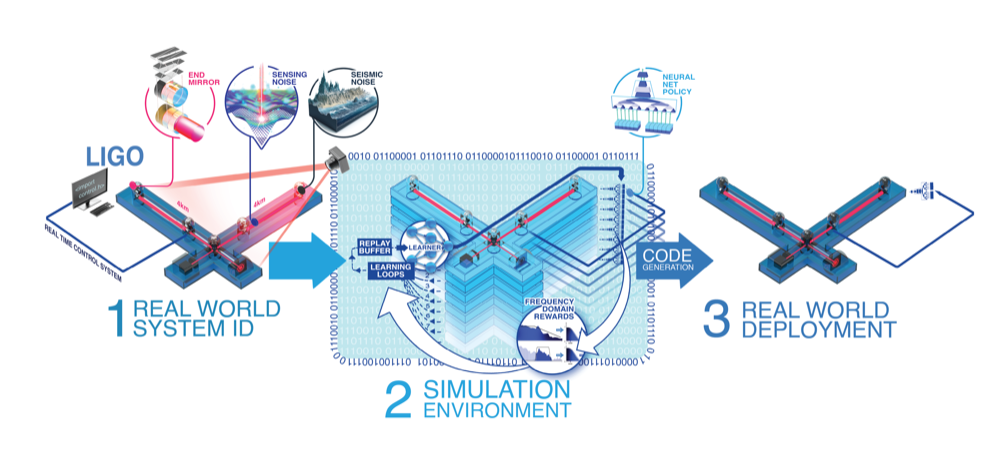
RL for classical feedback control in LIGO
Apply reinforcement learning to design and tune classical feedback controllers that keep LIGO interferometers stably locked.
Learn more →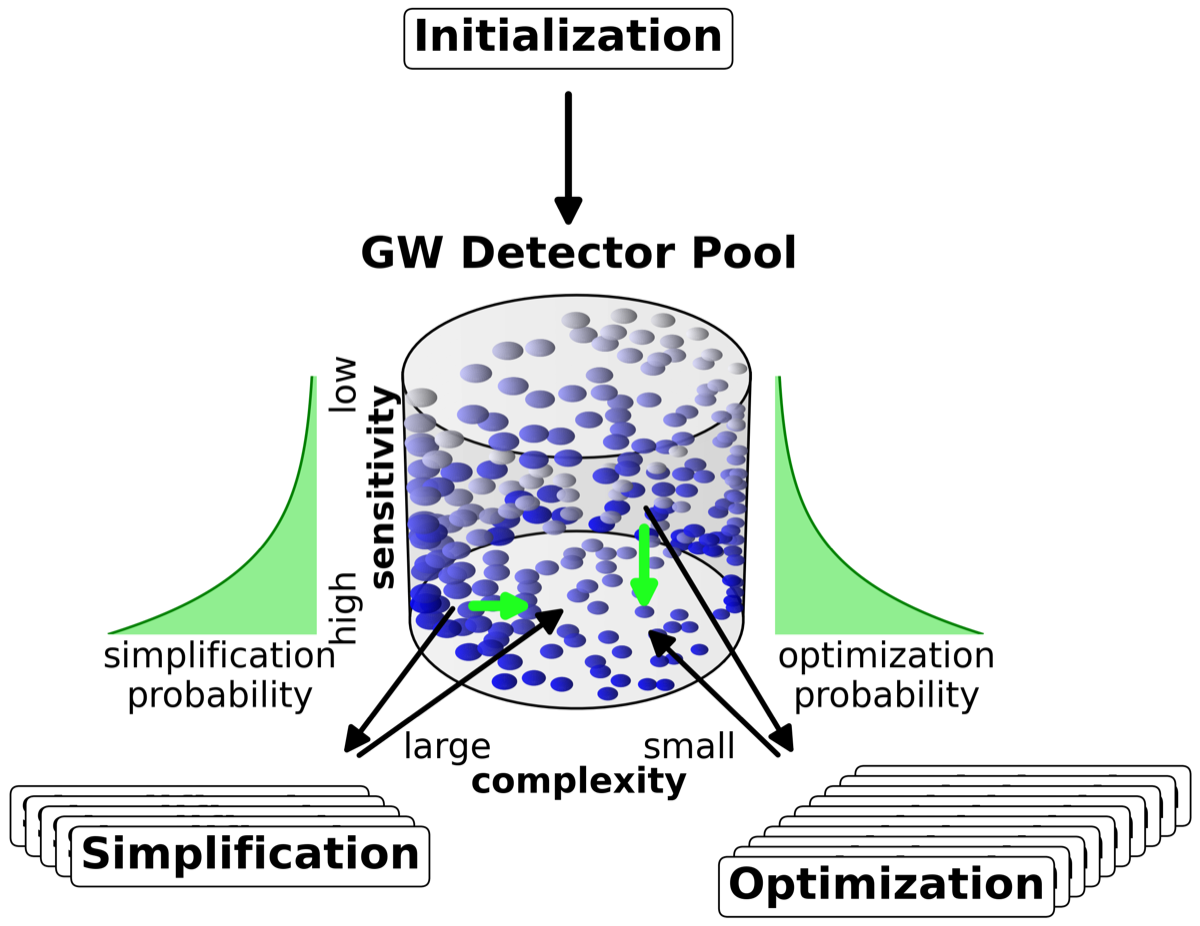
Generative Optical Design
Gradient-based optimization over universal interferometer models to autonomously discover detector topologies that outperform human designs.
Learn more →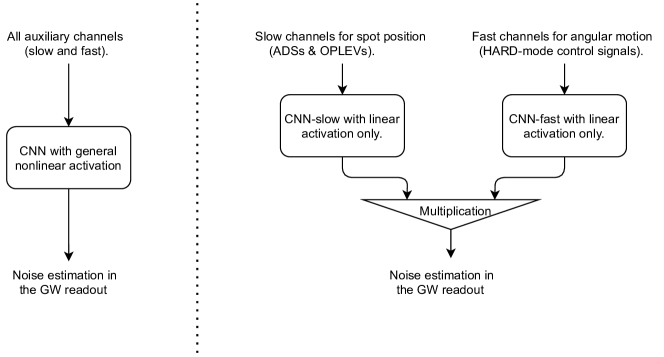
Neural Network Noise Cleaning
Convolutional and compound neural networks for nonlinear noise mitigation, data quality improvement, and real-time pre-merger early warning.
Learn more →
Digital-Twin Diagnostics & Forecasting
High-fidelity simulation models of gravitational-wave detectors that enable training ML controllers, accelerating commissioning, and predicting failures before they impact observations.
Learn more →Searching for Unmodeled Signals
Machine learning methods for detecting gravitational-wave transients that don't match existing signal templates, targeting unknown astrophysical phenomena and anomalous events.
Learn more →Selected Publications
Key papers on AI-driven control, design optimization, and noise reduction for precision experiments.
-
2025 Improving cosmological reach of a gravitational wave observatory using Deep Loop Shaping, Science.
Jonas Buchli, Brendan Tracey, Tomislav Andric, Christopher Wipf, and Yu Him Justin Chiu, et al.Abstract
Improved low-frequency sensitivity of gravitational wave observatories would unlock study of intermediate-mass black hole mergers and binary black hole eccentricity and provide early warnings for multimessenger observations of binary neutron star mergers. Today's mirror stabilization control injects harmful noise, constituting a major obstacle to sensitivity improvements. We eliminated this noise through Deep Loop Shaping, a reinforcement learning method using frequency domain rewards. We proved our methodology on the LIGO Livingston Observatory (LLO). Our controller reduced control noise in the 10-...
-
2025 Digital Discovery of Interferometric Gravitational Wave Detectors, Physical Review X.
Mario Krenn, Yehonathan Drori, and Rana X. AdhikariAbstract
Gravitational waves, detected a century after they were first theorized, are space-time distortions caused by some of the most cataclysmic events in the Universe, including black hole mergers and supernovae. The successful detection of these waves has been made possible by ingenious detectors designed by human experts. Beyond these successful designs, the vast space of experimental configurations remains largely unexplored, offering an exciting territory potentially rich in innovative and unconventional detection strategies. Here, we demonstrate an intelligent computational strategy to...
-
2021 Early warning of coalescing neutron-star and neutron-star-black-hole binaries from the nonstationary noise background using neural networks, Physical Review D.
Hang Yu, Rana X. Adhikari, Ryan Magee, Surabhi Sachdev, and Yanbei ChenAbstract
The success of the multimessenger astronomy relies on gravitational-wave observatories like LIGO and Virgo to provide prompt warning of merger events involving neutron stars (including both binary neutron stars and neutron-star-black-hole binaries), which further depends critically on the low-frequency sensitivity of LIGO as a typical binary neutron star stays in this band for minutes. However, the current sub-60 Hz sensitivity of LIGO has not yet reached its design target and the excess noise can be more than an order of...
-
2022 Nonlinear Noise Cleaning in Gravitational-Wave Detectors With Convolutional Neural Networks, Frontiers in Artificial Intelligence.
Hang Yu and Rana X. AdhikariAbstract
Currently, the sub-60 Hz sensitivity of gravitational-wave (GW) detectors like Advanced LIGO (aLIGO) is limited by the control noises from auxiliary degrees of freedom which nonlinearly couple to the main GW readout. One promising way to tackle this challenge is to perform nonlinear noise mitigation using convolutional neural networks (CNNs), which we examine in detail in this study. In many cases, the noise coupling is bilinear and can be viewed as a few fast channels' outputs modulated by some slow...
-
2020 Noise Reduction in Gravitational-wave Data via Deep Learning, Physical Review Research.
Rich Ormiston, Tri Nguyen, Michael Coughlin, Rana X. Adhikari, and Erik KatsavounidisAbstract
With the advent of gravitational wave astronomy, techniques to extend the reach of gravitational wave detectors are desired. In addition to the stellar-mass black hole and neutron star mergers already detected, many more are below the surface of the noise, available for detection if the noise is reduced enough. Our method (DeepClean) applies machine learning algorithms to gravitational wave detector data and data from on-site sensors monitoring the instrument to reduce the noise in the time-series due to instrumental artifacts...