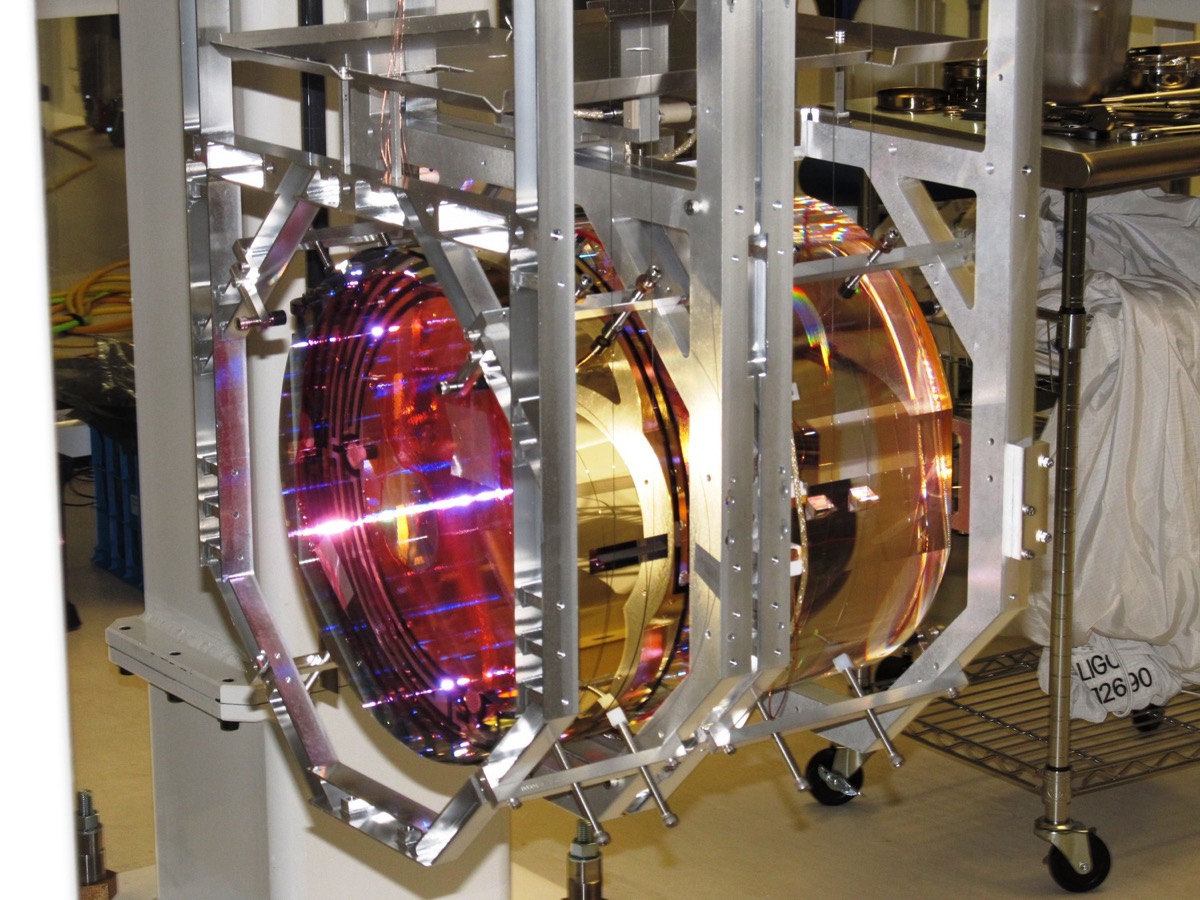
The Experimental Gravity Group organizes its work into five long‑term research pillars. Each pillar has its own page describing the scientific focus, methods, and current projects. Project pages provide short summaries now, with space to add figures, photos, and related publications as they are curated.
LIGO & Experimental Gravity Infrastructure
Build and upgrade the hardware and controls that make gravitational-wave interferometers work: lasers, optics, vacuum, suspension, and commissioning tools for current and next‑generation detectors.
- LIGO Adaptive Optics — Develop adaptive optics techniques to correct thermal and alignment distortions in LIGO interferometers, improving sensitivity at high laser power.
- LIGO India — Contribute to the design and commissioning of the LIGO-India detector, including infrastructure, control systems, and integration with the global network.
- Vacuum Beam Guide — Build and characterize a long-baseline vacuum beam guide as a quantum link between laboratories for interferometry and quantum networking.
Quantum Measurement & Control
Develop quantum resources and measurement strategies—squeezing, non‑Gaussian states, and quantum links—to push precision sensing beyond standard quantum limits.
- Waveguide squeezed light source — Build integrated nonlinear waveguide sources of squeezed light for compact, robust quantum-enhanced interferometry.
- Quantum Control for Metrology using non-Gaussian states — Explore quantum control protocols that prepare and use non-Gaussian states to beat standard quantum limits in precision measurements.
- Vacuum Beam Guide — Build and characterize a long-baseline vacuum beam guide as a quantum link between laboratories for interferometry and quantum networking.
Quantum Gravity & Foundational Physics
Design tabletop experiments that probe quantum aspects of gravity and test foundational questions at the interface of quantum mechanics and spacetime.
- Tabletop tests of quantum gravity — Design tabletop optomechanical experiments that probe quantum aspects of gravity and potential deviations from standard quantum mechanics.
Frontier Photonics & Energy Systems
Create high‑power photonic systems where coherence, damage thresholds, and feedback control are central challenges, with applications from advanced interferometers to energy‑relevant laser platforms.
- Sum Frequency Generation for high QE wavelength conversion — Use sum-frequency generation to convert photons between wavelengths with high quantum efficiency for low-noise sensing and readout.
- Optical Enhancement Cavities for Laser Fusion — Develop high-finesse optical enhancement cavities to recycle and shape laser pulses for inertial fusion and high-energy-density physics.
AI for Experimental Physics
Apply machine learning and control to complex experiments: faster lock acquisition, robust operation, automated diagnostics, and design optimization for precision instruments.
- RL for classical feedback control in LIGO — Apply reinforcement learning to design and tune classical feedback controllers that keep LIGO interferometers stably locked.